19 December 2007

The Internet is a Many Splendored Thing

Why are all of the Google ads on my DailyLit email of Anna Karenina about pole dancers? Oh the scandalaciousness of those Russian balls!

Speaking of experimental reading forms, I've been reading a short story called "goodcaptain" (based on "Benito Cereno" by Herman Melville) on Twitter all this semester. Basically, the story comes out a few sentences each day. A good twist on the old serial novel, and it's surprisingly easy to follow. The story's reaching a climax, so you still have time to subscribe on Twitter or Google Reader. It's free!

I'm considering writing a top 10-20 highlight list for this blog. Is this appropriate since I've sort of let it die? On the upside of this, my husband has threatened to make me a new blog over Christmas break, on our own server space and everything. Shiny. I think my New Year's Resolution will be to get back into blogging. All in favor, say aye.

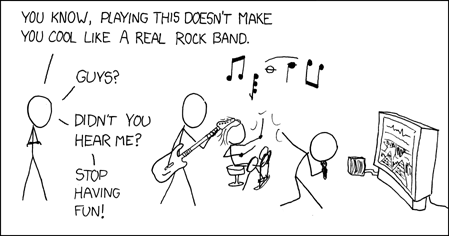
The following comic proves my geek theory--people are just jealous of us:

12 December 2007

It's not all about Card: Mormons and Science Fiction

All right, all right. After much harassment from Ben, I've been compelled to post something on my blog about what I've been up to. I just handed in a final paper with the title "Of Saints and Starships: The History of Mormons and Science Fiction." No, it is not all about Orson Scott Card. Seriously people. It's a twelve page long beast listing many of the intersections of Mormonism and science fiction. Here's some interesting excerpts, none of which include the ever delightful Card:

There are two strains of thought on the relationship between religion and science fiction. One view is that these two are inevitable partners because of their scale and themes, a view best represented by C. S. Lewis: “If you have a religion it must be cosmic; therefore it seems to me odd that this genre [religious science fiction] was so late in arriving” (Lewis 125).

. . .

The first [Mormon science fiction] is a short story/play by Parley P. Pratt in 1844 entitled “A Dialogue between Joseph Smith and the Devil,” which portrays a conversation between two regarding the success of the Restoration. . . . . As a work of science fiction, it must be admitted that the piece is fairly shallow. Most of the speculative fiction elements fall into the accusation that religious science fiction is primarily allegorical—the story exists primarily to convey a barely veiled ideas attempt to preach the Mormon message. However, this story undeniably represents an attempt by a Mormon to represent the tenets of his religion through speculative fiction framework.

. . .

Ironically, the short stories of inactive Mormon Zenna Henderson from the same period [1950s-1960s] show a more obvious LDS influence. In 1951, she published the first of her “People” stories. Her stories featured an alien race, dubbed “the People,” forced to emigrate to Earth because of the impending destruction of their home planet. Landing in the southwestern United States (Henderson spent most of her life in Arizona), the People established a society separate from humanity both to preserve their unique culture and to prevent harassment because of their unique psychic gifts. The analog to the establishment of Utah by the early Mormons is obvious, though it has apparently never been commented on by scholars . . . .

. . .

Additionally, three collections of specifically Mormon science fiction were published during the late 80s and early 90s entitled LDSF: Latter-Day Science Fiction (Thousand Oaks, CA: Millennial Productions 1982). These collections were inextricably tied to Mormon culture: the second volume contains an introductory essay by Hugh Nibley and stories that speculate on missionary work involving time travel and a future church where only women have the priesthood. (A copy with margin notes by Hugh Nibley can be found in the BYU library’s Ancient Studies room.) These collections are of mediocre quality and are generally little known . . . .

. . .

Six main themes of science fiction which coincide with the interests of Mormon theology:
1. The identity of the human race and possibilities for human progression
2. The identity of the individual; questions of destiny and free will
3. Explanations for the “homesickness” of the human soul
4. The identity of God; the conflict posed by discovering other belief systems
5. Responsibility for personal actions; the ability to atone for mistakes that affect others
6. The ideal structure of society; the treatment of fellow beings

. . .

Michael R. Collings studies several mainstream science fiction stories with prominent references to Mormonism, the most notable being the satiric “Fosterite Church of the New Revelation” in Robert Heinlein’s Stranger in a Strange Land (New York: Berkley, 1961); the sexually repressed hypocrite Nephi Sarvant in Philip Jose Farmer’s Flesh (New York: Signet, 1986); and the attempt to theologically sanitize Mormonism in Piers Anthony’s Planet of Tarot trilogy (New York: Jove, 1979) (Collings). In other words, . . . many of the Mormon stereotypes of the 19th century had survived intact in genre fiction, and specifically science fiction.
If you're interested in this stuff you might check out the following websites:

16 November 2007

Fathers

A response to Brian Doyle's essay "Two on Two":

Dear Mr. Doyle,
I really enjoyed your essay. Freshman year at BYU, I saw a Japanese film called Twilight Samurai, about a father dedicated to his family, giving everything so his two girls will have a mother and a future. Ever since, one of the themes I’ve been really fascinated with is fatherhood. It doesn’t seem like there are a lot of good examples of fatherhood out there. Unlike for women, there isn’t a lot of discussion in the world about what it means to be a man and how a man should relate to a family. As a recently married Mormon woman, I look at my husband and know that he has been raised—indoctrinated, really—to believe that a family and children will be the pinnacle of his life. He gets this not only from our religion but also from his father who teaches in the School of Family Life here at BYU. I look at these two men, my husband and my father-in-law, and compare them to the images I see of men in the media: anti-social gamers, the protagonists of shoot-em-up films, sports stars, high-powered corporate lawyers. When was the last time you saw a film about a man who was really comfortable with his family? And they say that women face the problem of a false media image? Thanks for writing about what’s real, the simple joy of life.
-Liz Busby

28 October 2007

One Hundred Percent Perfect

This weekend was our stake conference, and I confess I found it rather frustrating. Our stake president has recently commenced a program called "100% for 100 Days." The program is for all members of our stake to be 100% perfect in the following goals from the institution of the program (Sept 17th) until Christmas:

Daily
  • Individual and family prayer
  • Individual and family scripture study
  • Acts of love and compassion to spouse
Weekly
  • Date with spouse
  • Family Home Evening
  • Sabbath observance at ward of record
  • Magnifying of calling
Monthly
  • Fast and payment of tithes and offerings
  • Temple attendance
  • Home and visiting teaching

Now, as several talks pointed out in stake conference, this program really isn't anything new; it's simply a recording of all of the Sunday School answers, the daily/weekly/monthly demands that being a faithful Mormon makes on our lives. These are in essence the things we believe will increase our spirituality and sensitivity to the Spirit. (Though I'm disappointed they left out keeping a journal, but never mind.)

I have no problem with the actual substance of the program. My problem is in the presentation--this program is unmerciful, unforgiving, un-Christ-like. The goal is not "see how much you can do" or "see how much you can improve," but "do it all or fail." That was how it was presented in every talk in stake conference.

My problems with this program are:
  • It doesn't allow for any repentance. If you miss a day of scripture study, your 100% is gone. Too bad, you lose, good day, sir. It portrays our spirituality as a fixed state rather than a process. There's no change allowed in this program.
  • It doesn't allow for different starting levels of personal growth. The stated aim of the program is to help us achieve greater spirituality. But for some people, this won't even be a stretch, and for some, it's too much at once.
  • It doesn't allow for personalized goals. Although I'm glad the program doesn't go so far as to state how long our scripture study ought to be, it sets a definite bar of what is good enough, which could lead to apathy for doing more (because you already meet the baseline). What if something vital to my spiritual growth isn't on the list?
  • It doesn't allow for grace and the atonement, by making us think that if we can do these things, then we are good Church members. While there's definitely a correlation, I don't think this is an "if and only if" condition.
Now, I realize that Christ commands us to "be ye therefore perfect." But if this was the way He demanded it, there would have been no atonement given, because those who didn't do it perfectly would have completely failed. I'm just hoping and praying that this program is a set-up to teach us we can't do everything, and that it will end in December with a massive fireside on grace and the atonement.

But it probably won't.

As a matter of full disclosure, I must say that my husband and I are not 100% perfect. We didn't get around to our home/visiting teaching last month and occasionally we miss our prayers or scripture study. However, we have been attending the temple more than monthly. In my estimation, we're doing fine great.

Thoughts? What do you think of such a program?

16 October 2007

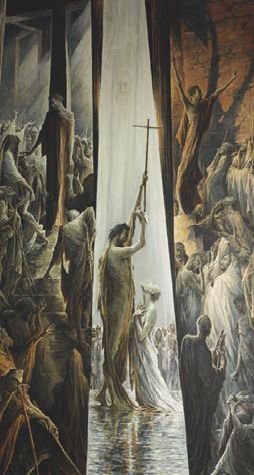
On Sergei Chepik's The Public Ministry of our Lord


Is this Christ my Christ?

Emaciated, spectral
lusting for divinity

A figure in bloody majesty
preaching to the dead
whitened ashy crowds

Not one who heals
but a sword
reminding of darkness
when all is light.

Are violence and weightlessness
my sure foundation?
Can this be my rock
divine form barely restrained
from flight?

15 October 2007

"Write Them Down": Writing to Transform Life

Crossposted from Blogger of Jared--my first real post there.

One of the funny things about being a writer is that you have to be somewhat narcissistic. You have to think your words are important enough to share. To quote Orson Scott Card:

Let's face it. You don't start writing fiction if you didn't have a healthy dose of vanity and ambition. What could be more arrogant than to believe that stuff you make up out of your head will be so pleasurable to others that they ought to pay you to be able to read it?

Although the quote applies specifically to fiction, the point applies to writers of the personal essay, and even journal writing. If you’re not, say, Winston Churchill or Ghandi, why is your life important enough for me to spend any time on, not even taking money into consideration? I've talked to many people who've pushed off journal writing with just this attitude. I’ve even felt it myself--the guilt of writing something of no importance. It seems wasteful. As I’ve been working on personal essays for my honors thesis, I’ve rediscovered how plain my life is: no physical disabilities, no abusive family, no major obstacles, no major accomplishments, no strange events, no extraordinary revelations, no doubts. It's just life, all PB&J sandwiches and afternoon TV programs, bland and continuous. Perhaps the only thing unusual about my life is how ordinary it is. I suffer, as I’m sure many do, from a form of angst envy, wishing that my life was just slightly more interesting. But not too interesting, of course--I'm not asking for major trials, just something worth talking about.

Strangely, being Mormon solves this problem: our religion is one with a strong belief in the importance of every individual. We’re one of the few branches of Christianity who believes God isn’t some omniscient blob, but a person with a body and a personality. We believe that simply by your membership and your humanity, you are qualified to instruct others in sacrament meetings and gospel doctrine classes. In our temples, we do work for individual people, one at a time, slowly slowly. The insane scope of our temple work project has only recently hit me: do we realize it will take more than a million years of cumulative two-hour endowment sessions to cover the earth’s current population, not to even begin to think about those who are dead?

Most importantly, we believe fervently that each individual has direct access and right to revelation from God. To us, or at least, to me, God is not only someone who enacts our salvation, but someone who cares about our mundane lives, who inserts the little "tender mercies." That intense divine interest and compassion qualifies every life as important reading material. President Eyring’s talk in the Sunday morning conference session, "O Remember, Remember," makes this same point:

I came home late from a Church assignment. It was after dark. My father-in-law, who lived near us, surprised me as I walked toward the front door of my house. He was carrying a load of pipes over his shoulder, walking very fast and dressed in his work clothes. I knew that he had been building a system to pump water from a stream below us up to our property.

He smiled, spoke softly, and then rushed past me into the darkness to go on with his work. I took a few steps toward the house, thinking of what he was doing for us, and just as I got to the door, I heard in my mind—not in my own voice—these words: “I’m not giving you these experiences for yourself. Write them down.”

I went inside. I didn’t go to bed. Although I was tired, I took out some paper and began to write. And as I did, I understood the message I had heard in my mind. I was supposed to record for my children to read, someday in the future, how I had seen the hand of God blessing our family. Grandpa didn’t have to do what he was doing for us. He could have had someone else do it or not have done it at all. But he was serving us, his family, in the way covenant disciples of Jesus Christ always do. I knew that was true. And so I wrote it down, so that my children could have the memory someday when they would need it.

As President Erying says, “forgetting God has been such a persistent problem among His children since the world began.” Therefore one of the first commandments of God to his people has always been for them to keep a record of their interactions with him (Moses 6:5,46). These records not only record our lives, but transform them:

I wrote down a few lines every day for years. I never missed a day no matter how tired I was or how early I would have to start the next day. Before I would write, I would ponder this question: “Have I seen the hand of God reaching out to touch us or our children or our family today?” As I kept at it, something began to happen. As I would cast my mind over the day, I would see evidence of what God had done for one of us that I had not recognized in the busy moments of the day. As that happened, and it happened often, I realized that trying to remember had allowed God to show me what He had done.

I used to be bothered by this idea that reflection inserts revelation into our past. It seemed like creating something out of nothing. It was a stretch, like wresting the scriptures, wasn't it? But over the past year of developing my own writing I've seen ordinary parts of my own life--going to school, visiting a museum--transformed into some of my most meaningful memories because I wrote about them. This process of living and then realizing is simply part of being human. We don't have the mental capacity to realize the implications of what's happening at the moment we're in it. I think there's a reason that pondering is in the primary song along with searching the scriptures and praying. If we don't think, we miss much of what the Lord has to say to us. We must study out our lives in our minds to find the things of eternity.

But finding these revelations in your life is not the last step. That whispering voice told President Erying, “I’m not giving you these experiences for yourself. Write them down.” Where would the Church be if Nephi had ignored the command to make a second set of plates? As spirit children of God, our experiences count for something. Again, there's a reason this Church has no paid ministry and I believe it is because we each have something to teach and something to learn. How you saw God's hand in your life might help someone else, either by testifying of God's love or by helping them to see things in their own lives. It doesn't matter your background, your education, your doubts: write them down and share them as inspired by the Spirit.
01 October 2007

The Church's Rhetorical Dilemma

I was quite refreshed by the tone of the General Relief Society meeting this year. Just naming the hymns alone will make quite a statement: "Redeemer of Israel," "High on the Mountain Top," "The Lord is My Light," and one more that I can't remember of similar active vein. It was nice, for once, to actually have to think during a GenRS meeting

Not that the talks were stunning. I could feel the list of three things in Sister Beck's talk coming from a mile away--but it had good moments too. I confess that I found Sister Allred's talk slightly boring, although I did enjoy listening to her accent a lot. Sister Thompson carried that day with an interesting hybridization of gospel truths and worldly experience.

But in spite of their flaws, the talks had real substance. They weren't the pat on the head talks that have become the butt of so many GenRS vs. GenPriesthood meeting jokes.

Apparently though, the Church just can't win when talking to women. Katherine wrote a post complaining how either it's patronizing us with how great we are, telling us not to be depressed, or it's how we need to be the best, telling us to do better. Neither mode is satisfactory. But is there a point in the middle? After reading Katherine's post, I was left asking, "Well then, if they can't tell us we're good enough and they can't tell us to be better, how can the Church talk to women?"

If we have to pick between the two, I'd personally pick the latter--like Sister Beck said in her talk, the best cure for loneliness and depression is the get out and do something. It seems to me that the reason for the first, conciliatory mode of speaking is solved by the second--action. It seems to me that the recent move towards coddling has been mostly due to increased awareness of depression in the Church (and perhaps the Church's hyper-reaction to the problem--it has the same flavor of over-correction as affirmative action). Maybe this is just because I've found ways to deal with my own feelings of inadequacy through moving forward.

But in actuality, both the conciliatory and the active roles are parts of the gospel. The repentance process can be distracted by a perversion of either. Satan tries to convince us that we are flawed beyond hope or that we can perform our own salvation. But actual salvation needs the true nature of both. And perhaps so does the attitude of Church speakers toward their audience. Too much condemnation or acceptance is stifling to eternal progress. We must make the gospel something within reach, which is perhaps why President Hinckley's "small steps," "stand a little taller" motif works so well--it promotes action, but makes it reachable rather than hopeless.

27 September 2007

Random Thoughts On Authorities

Since my ward has tickets to the General Relief Society meeting this year and thus my mother and sister and possibly aunts will be going together, I decided to read through the biographies of the Relief Society General presidency. This will be their first General Relief Society meeting since being called and sustained in April 2007 conference. This Relief Society presidency is surprisingly, almost consciously representative: one BYU graduate and full-time homemaker and mother with little leadership experience, one from a Latin American country who's been on missions with her husband, and one single career woman (with apparently no church experience worth mentioning in her online bio--is this just because it's less likely for unmarried women to receive leadership callings in the church?). This kind of diversity is probably easier to accomplish in auxiliaries since they change much more frequently than the General Authorities.

This has led me on a spree of semi-legitimate research on General Authorities (though I suppose technically the RS presidency are general officers) and from there to priesthood in general. Prepare for much disorganized randomness.

According to this site, "Patriarch to the Church is one of only two positions in the Church to which one may be called by right of birth (and, of course, worthiness)." Now I thought I knew everything about Mormon culture, but what in the world is the other? Something to do with Levites? Ah-ha, says Wikipedia. "According to Latter-day Saint scripture, a bishop does not need to be a high priest nor does he need counselors if he is a Levite and a direct descendant of Aaron, Moses' brother. In the LDS Church, there has never been a bishop selected under this doctrine, and such a bishop could not fulfill all the duties enumerated above (such as serving as the presiding high priest of the ward)." I forgot about that. Where in scripture does it say this and to what purpose? D&C 107:16-17. Hmm. Interesting. And no one has ever used it. I wonder if anyone in the Church could.

And what about those number limits on the size of quorums? What's that about?

A very interesting article by Elder Packer on priesthood government, a lot of stuff from which I didn't know. I think they should teach more about the organization of the priesthood in Relief Society, and for that matter Young Women's. You get a brief lesson or two about it--mostly on how to support the young men by dressing modestly and telling them to cut their hair, or later on how to help your husband honor his priesthood by asking him to move heavy objects for the neighbors. All right, that was a little overstated, but I think helping all members to better understand Church organization ought to be something we focus on. Women and men of the Church rely on the priesthood equally: we ought to understand it equally. I know I sometimes feel intimidated by return missionaries with their mysteriously obtained knowledge of the order of the priesthood, ordinances, and Church government. Is there a real reason to be secretive about these things?

And do men really learn this stuff in Priesthood, or is it like a mission thing? We were going through George's mission stuff the other day for FHE (decluttering so that all of our stuff might actually fit in our capsule-like apartment). It was the first time I've ever seen the so-called white handbook, and as I flipped through the pages, I thought, "Gee, why was I never taught all this stuff?" As a woman in the Church, I've only learned how different types of blessings are supposed to be performed by observation. Obviously, I'll probably never need to perform them myself--though unlike the Gospel Doctrine teacher in our singles' ward, I do know that women in the early Church could and did perform blessings, and still perform ordinances in the temples. Regardless, though, of whether I'd use it is the question of simple knowledge. Knowledge is the best guard against false doctrine and folk practices.

On the other hand though, Mormonism is a religion that runs on continual revelation. Perhaps providing extremely strict guidelines would limit the "creativity" that is so vital to our religion.

So that was random, but hey, I'm trying to gain some momentum here, so cut me some slack.

24 September 2007

Back from Hiatus

So, eh, it's been a long time. If my artistic expression weren't above it, I would now insert one of those anime-looking smilie faces with a nervous sweat drop coming off its face. Anyway, I apologize for being gone so long. I've been undergoing a whole bunch of life-altering changes. The ironic part about life-altering changes is that they make great material to write about, but when you are actually going through them, it's very difficult to do so. A synopsis of what has happened since I last blogged (August 1):


The Wedding
I got married. I suppose this is obvious, but I thought I'd include a few obligatory wedding pictures, all courtesy of Marisa's facebook since I don't have the candids from my parents with me and the photographer ones are all watermarked. George and I coming out of the temple. I love my dress (from Bridal Image, my aunt and grandma's bridal store in Bountiful).

My baby brother Josh (8) carrying my veil--the veil's my mom's.

Obligatory reflecting pool pictures. Note the awesome gloves and George's brown tux.

Me smearing George's face with some frosting after my cousin Barb specifically told us not to. :D This is at the reception in our backyard.

And yes, married life is great. But I see no point in writing about it since the single people will just be annoyed and hopefully the married ones already know.

And now I know I definitely disagree with Ben.


No More Double Major
I come back from my honeymoon one week late to the new fall semester at BYU and discover that physical chemistry is not really a chemistry class--it's a physics class in disguise! I passed the math class on which it is based with a C+ last fall. I hate physics with a passion because it's one of the few subjects that I have to work at. I proceed to stress out and have various mental breakdowns about my adequacy. George holds up admirably. I decide to quit the chemistry major and declare a minor instead. I am now trying to pick up the shattered pieces of my identity. Don't worry, I'll get over being a normal single-major-with-minor person like the rest of you. It'll just take time.


BYUAML Presidency
I'm now the president of the student chapter of the Association for Mormon Letters. I've started a BYUAML blog (of course) and a Google calendar to keep track of activities. I really enjoyed my first AML board meeting, and I'm flippin' excited about the Writing Conference on November 10th. Yay! I'm really interested in all the activities we've got going on, so I think it's going to be fun.


Miscellaneous Other

  • Working on my Honors thesis project, a collection of 4-5 personal essays on various aspects of being a Mormon woman.
  • Taking the LDS lit class and trying to narrow down the subject for my research paper. I'd like to write all twenty of them, but I think one will have to suffice.
  • Trying to find time to work on more Hugh Nibley stuff. I've been on a hiatus from working for Jack Welch and he probably wonders where I am.
  • Learning not to agree to do every project that comes along just because it would be so much fun. I have to have time to see my husband too.
So, I really will try to blog something real tomorrow, and it has to do with either 1 Cor 14 or D&C 93. Or maybe I'll actually post on Blogger of Jared, since I've been a guest blogger since April and written exactly nothing.

01 August 2007

We Write According to our Prophecies

An interesting scriptural exercise just came to me. Search your gmail account for "Christ" and consider this scripture:

And we talk of Christ, we rejoice in Christ, we preach of Christ, we prophesy of Christ, and we write according to our prophecies, that our children may know to what source they may look for a remission of their sins. (2 Ne. 25:26)
What? Only 62 emails out of 419 MB? And most of those are my daily mailings of Ensign articles from If Ye Are Prepared. And 20 blog entries out of over 200? (Ten percent?) Hmm.
And Christ is the Holy One of Israel; wherefore ye must bow down before him, and worship him with all your might, mind, and strength, and your whole soul; and if ye do this ye shall in nowise be cast out. (2 Ne. 25:29)

30 July 2007

Temples, Sacraments, Mysteries

"That is one of the reasons that I believe in Christianity. It is not a religion you could have guessed. If it offered us just the kind of universe that we have always expected, I should expect that we were making it up. But in fact it is not the sort of thing that anyone could have made up. It just has that queer twist about it that real things have."
- C. S. Lewis, Mere Christianity

In my current Hugh Nibley research, I've been reading (all right, skimming) books like A. D. Nock's Early Gentile Christianity and Its Hellenistic Background and Kirsopp Lake's The Religion of Yesterday and Tomorrow. This morning, in these and other sources, I ran across an interesting bit of religious wordplay. Apparently, the Latin-based word sacrament in ecclesiastical Greek becomes mysterion from which we get our "mysteries" (Lake 23). And from Nock:
A mysterion is a secret rite, in which the individual participates of his own free choice, and by which he is put into a closer relation with the deity honoured; normally he must undergo ceremonies of initiation (not usually capable of repetition) conferring a new and indelible spiritual condition and commonly giving an assurance of happiness hereafter. Those being initiated, says Aristotle, need not to learn something, but to receive an experience, and to be put into a frame of mind. The experience of the initiate may consist of acts done to him or by him, or again of the watching of a sacred drama. (Nock 5)
Reading that quote in context of the temple catches my intellectual breath in a way that hasn't happened since I found out covenant and testament are rendered from the same word. I confess that since my early Sunday school days, I've longed to find out what is meant when the scriptures refer to the mysteries of God. As a child, I was an avid learner, and this sounded like the best knowledge of all: "And if thou wilt inquire, thou shalt know mysteries which are great and marvelous; therefore thou shalt exercise thy gift, that thou mayest find out mysteries, that thou mayest bring many to the knowledge of the truth, yea, convince them of the error of their ways" (D&C 6:11). It seemed as though that knowledge was the apex of life, which of course, it is.

But as I prepare to go through the temple, I'm conceiving of the mysteries of God in another way: as sacraments, as ordinances, not necessarily something that we learn so much as something that we do. In the past, the importance of physical action in ordinances seemed to me out of step with religion which I saw as primarily intellectual and spiritual. Yes, I could see the symbolism in the action of baptism by immersion--the going down and coming up out of the water representing death and resurrection, the water acting as the physical sign of the cleansing of the soul--but in spite of all its beauty, my brain couldn't grasp why it was necessary to salvation: why should being covered in water at a certain point in your life actually affect the state of your eternal soul?

And I'm still not sure I can answer that question in an intellectually satisfying way. But what I have discovered is that religion isn't all about intellect. So much of it is about things you can't understand, predict, or explain, things that simply are as they are: "as it was in the beginning, is now, and ever shall be". If you limit religion to intellect, you make it what it should not be. One of the essential qualities of religion, says Lake, is mysticism. It is not logic. "It is not an emotion: it is a different form of consciousness" (Lake 178-9). It's the ordinances that we recognize as correct and satisfying without knowing why.

As I listening to a temple preparation lesson yesterday, I realized that the plan of salvation reminds me of nothing so much as the hero cycle, both in its steps and in its ubiquitousness. The hero's journey appears everywhere. There's no particular logical reason why it needs the steps Campbell assigns to it, yet they feel right. The plan of salvation just feels right, though I suppose you can't logically explain why it ought not to be some other way. This feeling of rightness is one of the things which can't adequately be explained by science: string theory, for instance, can explain the laws and constants of the universe, but can't explain why the universe would choose this particular set of constants from among all the other predicted possibilities. To science, to reason, they all seem equally likely. It is something beyond logic that says, "This one."

20 July 2007

HP7 Predictions: The Rest of Them

Rushing through the rest of Scholastic's seven questions, since it's the LAST DAY before the end of it all. Everywhere I go, people are talking Harry Potter. The receptionists at the ObGyn clinic were excited for the release. Every person I pass on campus is talking about their plans for midnight into their cellphone. The whole world is about Harry right now!


Question #3: Will Hogwarts reopen?

Duh. Of course it will. And Harry will be back in it. In spite of all the knowledge Harry received from Dumbledore in book 6, he really doesn't know much about where to begin looking for the horcruxes. And something always turns up when Harry's at school, so . . . . Plus I think it unlikely that McGonagall, as a member of the Order, will just roll over and give up on the school, essentially admitting that Voldemort has won. That's just not feasible. And as Joni said, these books are about Harry's seven years at Hogwarts, not six.


Question #4: Who winds up with whom?

Nice use of whom there, Scholastic. All I have to say about this is--for the last time, Harry and Hermione's relationship is platonic. Platonic, I tell you! You're all delusional!

Harry/Ginny and Ron/Hermione are shoe-ins, presuming Ron doesn't die. That's the only thing that could screw that up. But I think he won't. And too much of the books has been devoted to presenting not just the story of these couples but the reasons why they work. There's no way JKR is going to waste that. No freakin' way.

As for Tonks/Lupin, gosh, I hope they get together. At least one of the Marauders should end up alive, not evil, and happy. Lupin deserves it as a character, especially since he's done everything right. (Of course, he'll probably die now. Sadness!)

And if JKR hadn't explicitly told us there would be no Neville/Luna, I'd root for them too. And except Neville is so dead. Dang.


Question #5: Where are the horcruxes?

No, they're not just a hilarious song by Harry and the Potters anymore. Harry's got to find himself some serious horcruxes. I'm expanding this question to my guesses about the horcuxes' identities. Since there are six total horcruxes (making a seven-part soul all together), here's my analysis based on the HP Lexicon's list:

  1. Tom Riddle's diary: hid with Lucious Malfoy; destroyed by Harry in book 2.
  2. Marvolo Gaunt's ring: destroyed by Dumbledore in book 6.
  3. Slytherin's locket: hid in the cave; presumably destroyed by RAB
  4. Hufflepuff's cup: I'm not sure where this might be hiding. I'd guess Hogwarts, but since Slytherin's locket wasn't at Hogwarts, the others don't necessarily need to be there.
  5. Something of Ravenclaw's or Gryffindor's: I sincerely doubt he has both. I guess he didn't get Gryffindor's. Going by the tarot theory, Ravenclaw's artifact might be a wand or something.
  6. Nagini or maybe Harry: Nagini would be a very good touch--Voldemort would like being able to talk to himself. I don't think Voldemort would pick Harry as a horcrux though. But if he did, I subscribe to Orson Scott Card's theory of how it would be eliminated.
As for horcrux locations, clearly they're all going to be somewhere meaningful to Voldie. Places that haven't been used yet--the Riddle house, Hogwarts, Godric's Hollow?


Question #6: Will Voldemort be defeated?

Yes. He dies. Ginny, Ron, Hermione, Neville, and maybe Luna all help, but in the end it's up to Harry alone.


Question #7: What are the Deathly Hallows?

Hallows refers to something or somewhere sacred. Deathly meaning it can cause death, or looks like death, or is in someway connected to death. I can think of a few possibilities:
  • First, the horcruxes themselves. They certainly are deathly.
  • A place where Harry looks for the horcruxes, perhaps somewhere at Hogwarts.
  • The place behind the veil in book 5--Harry may need to go there somehow because he needs advice from dead friends.
And now, I will stay away from the computer until I finish reading the book. Gah! People in England are getting it now!

19 July 2007

Spoiler Outrage

A letter I recently fired off to letters@nytimes.com:

To whom it may concern:

I'm writing to express my disappointment with the New York Times' decision to publish an early review of Harry Potter and the Deathly Hallows based on spoilers leaked prior to the book's publication. Although going after the exclusive scoop may or may not be good journalism, it's certainly bad citizenship in the world community. Millions of fans are waiting patiently to read the book--with no desire to find out what happens early--and the information you've chosen to share could ruin the experience for many of them who trust your newspaper for accurate and sensitive delivery of the news.

I'm extremely saddened by your newspaper's unwillingness to help preserve the integrity of what Orson Scott Card called "the most significant event in English language literature in decades." But I guess that's what we can expect from the newspaper who decided to create a children's best seller list explicitly to stop the Harry Potter books from continually topping the 'normal' best seller list, which belongs to more serious fiction--like the Danielle Steele novel that replaced them for the number one slot.

Congratulations on your literary integrity.

Sincerely,

Liz Muir
Harry Potter Fan, and member of Jo’s Army

Want to express your own outrage? Check out the instructions for The Leaky Cauldron's letter writing campaign. Be sure to include your contact information (name, address, and phone number) if you want your letter considered for publication. See also JK Rowling's response.

And all of the links in this post are spoiler free.

17 July 2007

Knowing the Bridegroom

And while they went to buy, the bridegroom came; and they that were ready went in with him to the marriage: and the door was shut. Afterward came also the other virgins, saying, Lord, Lord, open to us. But he answered and said, Verily I say unto you, I know you not. (Matt 25:10-12)
So it's been awhile since I've written a more serious entry, for reasons which should be obvious. But since my mind insists on formatting every thought I have into a blog entry, I guess I better recommit myself to the blogosphere.

One thing that I realized on my study abroad trip was the metaphors in the scriptures are anything but accidental. For one of our devotionals in England, I wrote a talk on why the scriptures refer to Christ as the light of the world. The implications of that metaphor are astounding to me. (I plan on revising that talk over the next few days to post on Blogger of Jared. Keep an eye out for it.) But the metaphor that's been snagging my mind lately is Christ as the bridegroom and ourselves as the bride, again for obvious reasons.

The lesson in Relief Society this week was "Thou Shalt Have No Other Gods before Me" from the Spencer W. Kimball manual. Our discussion veered off on the interesting tangent of how we can grow to love God more. As we listed all the typical answers, it struck me how apt it is to compare our relationship with Christ or God to a marriage. It seems from my limited experience that there are two ways we spend time with a spouse. The first is the process of life--buying groceries, looking over the weekly calendar, picking each other up from work, running errands, getting stuff done. The second is the specially set-aside time, time we make away from the work-a-day mill to spend with each other, the weekly dates the Church so frequently councils us toward. One isn't better than the other; both are necessary for a healthy relationship.

How well these two elements apply to our relationship with God! God is to be part of our everyday actions. We must be listening to spiritual promptings and doing the 'errands' of our spiritual lives--our scripture reading, our prayers--in His presence. Yet equally important is setting aside weekly time to meet with God, to commune together without an agenda of getting things done, just listening and talking and repairing our relationship.

How many of us can say we set aside time for a weekly 'date' with God, though? In my life at least, there's often much emphasis on relying on Him in my daily actions--the Spirit is my support through the day--and not enough of simply getting to know Him better. Much of my time with God seems about incidental convenience. Blogging time double-counts as pondering time. Writing in my journal is following the prophets as well as creating material for my honors thesis project. I can learn all sorts of spiritual things while also getting paid to work on the footnotes for the next volume of the Collected Works of Hugh Nibley. (Now they pay me to be obsessed with him. Yay!)

I'm not saying such double-counting is bad. God's presence should permeate our lives like light. But it gets to be a problem when I have a hard time thinking of that last time I did something to commune with God without the ulterior motivation of being productive elsewhere. That kind of relationship is exhausting. When George and I went through a few days doing nothing but working and planning wedding stuff, my ability to give and feel love was severely impaired. Without downtime in any relationship, you simply forget why you are doing things. And lack of downtime in my relationship with God leads me to forget why I push through the 'errands' of spirituality.

Another question is this: what do you do with one-on-one time with God? Unfortunately, I can't take God down to the Malt Shoppe for two-for-one Mondays. For me, the answer to alone time with God is prayer. At FHE, we discussed Elder Scott's conference talk on prayer, and this phrase from the "How Should You Pray?" section stuck out to me:
Don’t worry about your clumsily expressed feelings. Just talk to your compassionate, understanding Father. You are His precious child whom He loves perfectly and wants to help. As you pray, recognize that Father in Heaven is near and He is listening.
That description of open communication, without worry about clumsy phrases or entertaining the listener, is exactly the type of communication that ought to exist between spouses. That willingness to say whatever comes to mind, to talk about anything, everything, nothing, is exactly the way I feel when I talk with George. Prayer ought to be the kind of talk that comes of lying in a hammock with someone you love, staring at sky through the tangled leaves, where all life suddenly comes open, and in that instant you can fix problems that have taken years to form, or doing anything really. It's so vast yet personal--overwhelming to me.

11 July 2007

Movie Troubles

This is a review of the fifth Harry Potter movie. Spoilers, insofar as they can exist for a movie made from a wildly popular book, abound. Consider yourself duly warned.

I waited in line starting at 6 pm. When the movie ended at 2:30 am, I felt much like you might after completing a transatlantic flight: tired because of the marathon length, annoyed at the minor inconviences, elated by happy coincidences, and relieved to have arrived safely on the other side. Then the credits began to roll. When JK Rowling's name showed up, I clapped wildly like a fangirl child of the night, but a girl behind me started to boo loudly. I was baffled. People actually boo things? Movie screens? Authors who weren't even part of the movie?

"Well, I'm sorry," she said loudly, with her hands on her hips in her black robe, "but that movie sucked. It completely ruined the book." Instead of feeling an urge to tell her to shut it (as I usually do for people trying to make book/movie comparisons), I felt uncomfortable and quietly ignored her, as though the topic that she had brought up was slightly taboo. Normally, I agree completely with Joni on this topic: book/movie comparisons are irrelevant; movies don't erase books; movies don't have the same purpose as books; each form should be judged on its own merits.

But in the case of Harry Potter and the Order of the Phoenix, I'm not sure I can agree. My opinion may change with future viewings, but right now, the movie doesn't stand on its own very well. Courtney phrased it well this morning: it feels like an outline of the book. Anyone who hadn't read the books would miss a lot of the things that made the movie worth sitting through, like the random cameos of Aberforth Dumbledore, Percy Weasley, and for that matter Tonks and Shacklebolt. They seem like good space-filler in the movie, but you'd have to be a book reader to understand their importance. Kreacher felt very tossed in, even after JKR explicitly told film-makers he would be important to keep because of future books. The establishment of the Weasley's shop is mostly hinted at, and three scenes basically cover the whole Cho Chang angst.

In other words, the style that makes Harry Potter better than your average pulp-young-adult-fantasy-novel is completely lost on the movies. On key part of JKR's style involves including some detail seemingly for humor value early in the book--for example, Dumbledore's full name (Albus Percival Wulfric Brian Dumbledore, his name is my name tooooo)--and having it end up being an important key to the resolution of the book--Dumbledore's initials are on the prophecy and thus he's our link to being able to hear it after Harry smashes it. But since in the movie Harry hears the prophecy, there's no suspense about that. The inclusion of Dumbledore's name becomes an interesting detail but of no relevance. The details are there just for the coolness factor, a common flaw in children's fantasy lit where the author has fallen in love with their own ability to create--look how cool and detailed my world is! The movies turn Harry Potter into something that's just average instead of so astounding that the New York Times had to create a children's bestseller list in order to keep Harry from constantly occupying the top 4 spots of their main list (which of course rightly belong to "serious" writers *cough*).

Then there are the major alterations in the plot--Harry handing over the prophecy to Lucious, Sirius being AK'd instead of just falling through the veil, Voldemort possessing Harry. I'm not sure what to do with these. I actually like the Voldemort possessing Harry bit; it's a more solid resolution of Harry's angst problems, a better transition into book 6 than even JKR wrote (as hard as that is to admit). But the others not so much. And these changes are not just to the mechanism of the plot, but also the meaning. Mechanism changes have to happen in the movies, especially since so many sub-plots must be cut. Things have to happen in new ways. But meaning changes are problematic. How can Dumbledore trust Harry in book 6 if he's willing to hand over the prophecy to any old death eater who's going to kill some people? It simply doesn't pan out. Movie 6 & 7 could end up completely different from the books of the same title. If the movies are trying to stand on their own without the books, I guess this is one way to do it, but unfortunately for me, the main point of the movies is to be able to experience that same story with other people. (Maybe I am making the argument that the books and movies should be the same . . . well, it is what it is.)

What did I like about the movie? I liked the separate development of Neville and Luna. Their character depth was better than I expected from the movies. Ginny needs more facial expressions, but I like the implied jealousy of Harry/Cho. (Ginny could also use more purposeful strength rather than accidental power. But maybe I'm biased about that because Ginny's character development in book 5 was a major point in my IB thesis on gender roles in Harry Potter.) After all my rant about the details, this movie does feel more magical than previous movies--the existance of a wizarding world feels real. The newspaper headlines rock especially.

Yeah, so I had a blast watching the movie. But I'm glad that's over. Now I can look forward to what really excites me: book 7! (More predictions coming this week, along with some non-Harry posts this week. I promise!)

And now after all this seriousness, here's a cartoon losely based on Harry in book 5: Wizard Angst. That summarizes the whole book/film pretty well. *insert brick wall here* Angst, angst, angst, angst . . . .

06 July 2007

A Simple Solution

You are a soon-to-be-married geek couple at BYU who just decided to move your wedding from December 28 to August 30. In your high-speed search for married housing, you:

A) create a spreadsheet from BYU's inadequate family housing search, eliminate entries that are too expensive or too late, then proceed to rank other information such as distance from campus and furnishing, sorting the spreadsheet to your heart's content;
B) make a Google map of the locations of the housing you are considering and color the icons to show which are near and far from campus;
C) write a program to automatically generate emails to the owners on your spreadsheet, letting them know of your interest in the property;
D) all of the above and now you can't stop giggling about how much fun it was.

30 June 2007

Duum Dah Dah Dum

So some people on the study abroad guessed this was coming, and my family knew four days before I did (Heather, I may kill you later), but for the rest of you--I'm engaged to become the future Mrs. George Busby.

Now I'm going to go to sleep and hope this isn't a dream.

29 June 2007

Rating

Online Dating

I'm just glad I didn't do this back when this post was on the main page. It's apparently rated R. I suppose that makes sense. The best part about that post was that it caused my blog to be blocked by the firewall at George's parent's house. :D (Hat tip to Times & Seasons.)

HP7 Predictions: Is Snape Good or Evil?

Ah! I can't believe it's almost July! So little time to weigh in on important Harry Potter issues. Better get cracking on Scholastic's seven questions. The next question is one we all could see coming:

Question #2: Is Snape good or evil?

Well, this is it. The big one. The one we've all been waiting for. (We know Oliver's speech by heart, said George. Heh heh.) Although for most of us the answer seems pretty obvious, I'll list Scholastic's choices here just for laughs:

  • Good and still a spy for the Order of the Phoenix
  • Good but in too deep with Voldemort
  • Evil and has always been a spy for Voldemort
  • Evil but only because Voldemort is back
For me, this is a no-brainer. It only took a few hours after the initial trauma of finishing book 6 for me to figure out that JKR had set us all up. First, look at the ambiguity of the infamous chapter "The Lightning Struck Tower." Dumbledore never actually begs Snape to spare his life--what he's requesting of Severus is left purposefully unstated. All he ever actually says is "Severus . . . Please . . ." The implication is that he's begging for his life, but it's never actually said, a classic JKR trick, playing on our assumptions.

And why would Dumbledore use his last spell to freeze Harry in place? Perhaps he was trying to protect Harry, but in the previous chapter, Dumbledore makes it clear that he's willing to entrust Harry with both their lives. Since investing Harry with Dumbledore's trust was the purpose of that chapter, it doesn't make much sense for him to suddenly grow protective again. The next easiest explanation is that Dumbledore froze Harry in order to prevent him from interfering. Dumbledore knew what was going to happen would look bad to the impulsive, teenage Harry and therefore had to use his last spell to prevent him from disturbing what had to be.

The final key to Snape's innocence lies in the oft forgotten overheard conversation between Snape and Dumbledore. Hagrid tells Harry on page 405:
". . . I was comin' outta the forest the other evenin' an' I overheard 'em talking -- well, arguin'. ... I jus' heard Snape sayin' Dumbledore took too much fer granted an' maybe he -- Snape -- didn' wan' ter do it anymore ... Dumbledore told him flat out he'd agreed ter do it an' that was all there was to it."
More purposeful ambiguity. If we believed that Snape was evil, we might interpret this conversation as Snape's turning point, his warning Dumbledore that he took Snape's loyalty for granted and ought not to. But why would a double agent do such a thing? Snape would be of maximum use to Voldemort by remaining in Dumbledore's trust, not by warning the headmaster that he was considering defecting. (Although, I suppose there's a satisfying alternate interpretation: Snape's loyalties really were divided. Maybe he was sick of the double agent routine and just wanted to stop being used. Perhaps he wanted out. I think I would feel okay if that turned out to be the case.)

But if we consider this conversation in light of what what Snape had "agreed ter do" in chapter two--that is, complete Draco's task should he fail to kill Dumbledore--the conversation makes complete sense. Snape knows what will happen if he goes through with his promise: all that everyone's trust of him is founded upon will be completely destroyed. Snape is basically sacrificing everything by killing Dumbledore; he will have nothing to fall back on; he'll have cried wolf one too many times. Even if the real story came out, he'd have to work even harder to gain anyone's trust and friendship. Snape becomes a permanent outsider to the group he's already chosen to be loyal to.

Yet even killing Dumbledore was better than the alternative. Remember, Snape made an unbreakable vow. Had he not gone through with his task, he would have died. Granted, we have many questions on the exact implementation of the unbreakable vow--we don't know how the spell would tell the difference between not completing the task and not yet completing the task. The time restrictions aren't clear. But suffice to say, if Snape chooses not to kill Dumbledore, then Dumbledore lives, but the Order's only source of inside information dies. Frankly, Dumbledore's more dispensable at this point than Snape. Dumbledore's role as Harry's mentor has been fulfilled, but Harry has yet to accept that he must work with Snape rather than against him.

Just a week ago, I had my belief in Snape reinforced as my family drove around France and I listened to Half-Blood Prince on CD. The major theme of book 6 is how appearances can be different from reality: the ministry's campaign against Voldemort is mostly about public relations rather than progress; Percy's visit to his family isn't about love, but business; Draco's evilness turns out to be mostly fear about his family's safety; Harry tricks Ron into believing he's given him felix felicis; bottles from Weasley's Wizard Wheezes entering the castle in disguise; even the identity of the Prince. Appearances in book 6 are something to be questioned, which is a huge hint to how we ought to read Snape's actions in book 6.

Conclusion:
Snape is good and still a spy for the Order of the Phoenix.

Need more Snape debate? Check out this video of a discussion panel that took place at Phoenix Rising, a Harry Potter convention in New Orleans.

13 June 2007

A Kiss for Abortive Wings

I feel bad about not updating my travel blog recently. I've been typing out things on my USB drive but can't find an internet cafe that allows USB connections. Gah! So, just so you don't all forget about me and because I miss blogging a lot, here's a poem I've been working on.

When we first meet
I see the seams across your back
and wonder whose needle put them there.
In time, I notice you stitch them yourself.
Your needful contortions sucher
gaps between muscle and soul.

I dare not ask about the wounds
for I fear finding them
self-inflicted or inflicting me.
Your eyes are glad for my silence
so I dumbly watch your soundless cries
as we move through the forgiving dark.

But when I bring my hand close
to weigh your burden in my palm,
your wince stings
and cloaks again well-nursed scars.
You ask me to embrace you
but forbid our atoms to touch.

Perhaps if I had light or voice,
you might be able to see. Look:
I don't want you to be happy, only whole.
Stop forcing scabs to bleed hot
and allow the flaws in your clay
to beautifully complete imperfection.

When we last meet,
I see the seams across your back
and learn our wants are not the same.
Still, I lean in to press your lips
and run my hand across
the scars of your abortive wings.