Showing posts with label knowledge theories. Show all posts

04 March 2008

Heidegger and Mormonism: A Possible Literary Aesthetic

Another cross post from Mormon Renaissance--please leave comments over there.


In my last post, I discussed the idea of Mormon literature as an aesthetic–an idea of how writing should be, rather than a specific genre. I briefly mentioned one possibility for a Mormon aesthetic, the idea of respect towards all human beings and the belief in the power of human choice. Many commenters rightly suggested that this idea is not unique to Mormonism–it is a general Christian, or even humanist, ideal.

So I’d like to present another possible “Mormon” mode of writing, this one derived from the philosophies of Heidegger. The major realization of Heidegger’s philosophy is that one can gain only so much from creating a system of knowledge. He believes that conceptual knowledge is reductive of reality, imposing limitations where none exist. The key to overcoming the barrier of human thought is not more human thought but human experience, for in situations that our intellect cannot make sense of, our experience has no trouble participating. As a result of this emphasis on experience, Heidegger thought that writing ought not to seek systematic views but out to be participated in as an experience–a poem should not represent a world view, but be experienced as a world of its own. This idea about writing seems to fit well with Mormon conceptions of what the written word can do and what it is.

I have often wondered over the fact that there is no explicit written Mormon theology. Sure, we have our scriptures and the Articles of Faith, which serve as at least a foundation, but when you think about it, they define only a very basic outline of our faith. It’s extremely easy to find points that can be and have been interpreted in multiple ways. And outside of scripture, any theological Mormon writings are a very delicate balance. Do we have room in our society for someone like CS Lewis, whose theological writings are mostly logic based rather than scripture or modern prophets? I don’t think so: I have yet to read any good logic-based theology from any LDS author. Yes, we have scholars like Hugh Nibley, but even those types are viewed warily from inside the establishment, and from outside of the establishment, it’s clear that they don’t derive LDS theology but use it as their assumption and continue from there. There seems to be a general perception that theological writings could get too scholarly and therefore detract from testimony and revelation.

From within Church correlated literature, the same is true: the ideas stay at a superficial level, never diving into the deep and controversial questions. I often feel a frustration over the fact that the Church doesn’t issue statements solving some of these basic controversial issues (particularly, of course, the ones on which I am right and other people are wrong, if they could only just understand properly). For this reason—not having a highly codified collection of doctrines like the Summa Theologica—Mormonism has often been called an orthopraxic religion, one that cares more about practice than an orthodoxic religion which emphasizes belief. This designation often feels like an accusation, and as a Mormon, I tend to be resistive to anyone who calls my religion a system of practices rather than a mode of belief. From this point of view, it would seem that writing in Mormonism is a futile exercise. The only texts that could be produced are essentially dogmatic propaganda or instructional books on practices.

But perhaps Mormonism is not really really all about practices but about their results. Like Heidegger, Joseph Smith believed there were some things that could not be understood only with words. When he commanded his followers to know the nature of God, he did not mean that we should be able to define Him in vague theological terms: to know the nature of God is not a command to study or think about him. In Mormonism, it is a command to reach out a meet him, face to face (a term that Levinas surely would have approved of). We believe that a knowledge of truth comes mostly through experience. The Book of Mormon is full of instances in which God told things to men which could not be written with language, not just that they were forbidden to write these things, but that they were unable to do so, perhaps because of the nature of language. Written things are seen as a limiting force in our religion.

Even our demand for correct practices, like daily scripture study, are really commands to find out truth through experience. In our reading of the scriptures, it’s not necessarily the words of the scriptures that we need. Rather, we seem believe that our presence in reading those books can open us up to receive other signs in our mind. It’s as though writing is not meant to convey knowledge, but to trip a switch, to create another experience all its own. We believe in revelation acting through the written word, not just through what it says, but through the very act of reading.

Perhaps this idea of literature as an experience could be a way around the much complained of didacticism of Mormon writing about spiritual matters. Instead of trying to explain our doctrines or show how those who make the right choices come to the right ends (one of the main faults of the Home Literature movement), our literature could focus on the reality of spiritual experience, trying to create literature that generates genuine spiritual experience. Of course, there are obvious problems with this: first, the highest Mormon spiritual experience, the temple, is mostly off limits in terms of writing. I have always seen this as a huge problem with taking Mormon literature seriously as a minority literature–we can’t immerse our outsider readers in the culture because it is forbidden to do so. Second, how does one go about creating a spiritual experience for the reader without presuming to be God and creating false revelations? And how do we keep this from becoming an aesthetic of manipulation? (Especially in film–cue the emotional music and fuzzy close-up.)

However, I think it still can be legitimately done. Actually, I think many Mormon artists are already out there trying to do just that–just think of the history of Church cinema. Some may think it a little manipulative, but at other times, it’s completely genuine in the world it immerses you in. The Mormon arts seem distinctively different than most post-modern literature in this way–we always genuinely have faith in the ability of arts to be an immersive experience, rather than a distant and cold examination of the world. Much of Mormon art has less regard for the nature of the medium and more focus on the subject matter.

What Mormon art has touched you in an experiential way? How can we develop this aesthetic into something legitimate rather than allowing it to devolve into a culture of propaganda and manipulation?

23 February 2007

Come, Let us Reason Together: A Nibleyesque Musing

I have one thing to say for the readings this week: Nibley’s “Beyond Politics” is pure genius! I especially enjoyed Nibley’s elaboration on how God wants us to understand the plan of salvation—how, unlike Satan, He cares to negotiate with us until we understand. “God is willing to discuss things with men as an equal.” So often, the world sees living a religion as necessitating blind faith, willfully ignoring the conflicts we see in the world. But this is so backward from what is real that it’s ridiculous. It’s the philosophies of the world that tell us to accept things as they are, not to ask why, but to simply accept that it is. “That’s just life,” the world tells us. It points out the huge gaping dilemmas, cries how incomprehensible the world is, and retreats back into ignorance. Heavenly Father, on the other hand, wants us to ask why, forces us to look at the tough questions and demand answers.

I think the world sometimes avoids religion because we are, as C.S. Lewis said, afraid that if we actually look for God, we would actually find Him, which means a great deal of responsibility. I’ve had friends come up against problems with the Church that they see as irreconcilable—whether it be why women don’t have the priesthood, why their parents got divorced, or why their loved one had to suffer or die. To me, it seemed that the only reason the problems remained for them is because they refused to demand answers from the source. They continued to seek out worldly philosophies on the subject, which they hoped might explain the problem but which inevitably brought more and more questions into their lives. They had laid down their scriptures and their prayers, which is where they ought to have been seeking their answers all along. When I find seemingly unanswerable questions, it’s often because I’m not looking in the right place for the answers.

Another great corollary of this discussion is that deciding to live a righteous life does not mean that all discussion ceases. As Nibley points out, even in the beginning, there was a counsel in heaven. In the Church, we sometimes portray this key discussion as more of a gathering for a one-way dispensation from God, but I think it’s important to notice the collaborative nature of the word. Nibley casts an interesting light on this: “Satan was not cast out for disagreeing, but for attempting to resort to violence when he found himself outvoted.” I’m not sure that I quite buy it doctrinally, but it certain fits into Nibley’s picture of the universe as an essential collaboration between God and men. After all, we believe our intelligences to be equally eternal with God’s; He’s simply further ahead in the plan than we are. Why shouldn’t we all have had a say in how things work?

In contrast with the godly reasoning Nibley presents in “Beyond Politics,” the worldly philosophies exposed in “The Way of the ‘Intellectuals’” look like the pathetic counterfeits that they are. Rather than equality and plainness of God’s “come, let us reason together,” the figures Nibley describes from the Book of Mormon rely on power, charisma, and elitism to make their points. If you disagree with them, it’s merely your lack of judgment. There’s no room for disputation as there is in the kingdom of God. It’s amazing just how plain the difference is when you put these philosophies side-by-side. It’s one of the reasons I’m glad to be studying at BYU. The “open” liberalism espoused by other colleges is actually more confining than they think—no universal truths mean the stability must be made up by embracing current trends. At BYU, however, being united in the gospel gives us a firm foundation for exploring all areas of truth.

23 January 2007

Flat Heresy against Intellectualism

There is not a sound here anymore
Except the neighbors singing opera next door;
And I am in the closet reading books.
You know, I never could quite find another soul I understood.
--Peter Breinholt, "My Little Town"
Recently, I've been disturbed by the idea that becoming educated is necessary to receiving exaltation. It's an idea that seems to thrive at BYU, since education and salvation are so constantly on our minds. In the Doctrine & Covenants we're instructed many times to seek learning, but is this a commandment that is necessary for salvation or is it simply a suggestion of how to build the kingdom? And what is the relative importance of socializing--being with people for no other purpose than to be with them--as compared to education?

Don't get me wrong, I love education. I'm much more comfortable with a book or a pen in my hand than with people. It takes me a while to recover from the overload of being in a large gathering. But more and more I wonder if my preference for books and learning is just that: a preference. Is there anything inherently important about reading the classics or learning science? (Oh, the heresy!) Are academics really in any substantial way higher than anyone else?

The problem with intellectualism is that we are encouraged to increasingly isolate ourselves from the outside world until, in the end, we begin to think that what we do is actually important. In a way, it seems to me that devoting our lives to academia is just as pointless and arbitrary as those who devote their lives to sports or fashion or television, only perhaps more insidious because our obsessive hobby has the illusion of eternal significance. But in actuality, all any of these groups are really doing is learning a set of conventions that apply to only one thing--the rules of a game, the trends of the day, the jargon of the elite, a set of novels to allude to. These sets of things to learn and master have no more real importance than a toy, something to bide the time as we are tested.

Is that all education is? A hobby? I'm beginning to lean towards yes. It's something we do because we enjoy it, but I doubt the inherent virtue some people read into it. Most of what we learn is convention, and the rest can be gained in such a multitude of ways that it seems silly to claim it as unique. It's only a matter of taste, it seems.

In Faith of an Observer, Hugh Nibley says something to the effect of the following: that the only significant things we can learn to do in this life are to repent and to forgive. None of us is particularly wise, particularly clever; we're all pretty much ignorant, but the two things we can do are to repent and to forgive. Intelligence, cleverness, and learning in this life are all an illusion. (Sorry, I can't find a transcript, so my memory will have to serve.)

So, if the rest is just a hobby, we should focus on how to repent and how to forgive. How to develop the first is obvious. We must develop our faith, our relationship with God, and our ability to realize our own nothingness. As Church members, we all know this. Nothing new here.

It is the second that interests me: developing the ability to forgive others. How would one go about it? And this is where we come back to the real purpose of socializing. All of these other hobbies we pursue--the humanities, sports, television--are simply ritualized ways of going about our real business: getting to know people. And not just know people as in, "Yes, I do know Bob in accounting," but know people as in understanding what makes them tick. Because, it seems to me, we must completely understand a person before we can possibly forgive them. Great examples of this in the omni-present Ender's Game. Charity comes primarily through comprehension of the person. (Perhaps this explains the unconditional love of parents. They understand their children almost completely.)

And even beyond the importance of general socialization, there seems to be special value in getting to know people who aren't like us--bridging social capital, if you will. I have learned so much this year by living with Kami, my elementary education major roommate. Our tastes in literature will never mix: she is bored by my sci-fi/fantasy, I gag over her romance novels; I want high philosophy, she wants believable life. It took me a long time, but I finally accepted this difference as a difference. It has nothing to due with her intelligence or exposure to the classics; it's 100% a matter of pure, inexplicable taste. She's part of the reason I'm questioning the importance of intellectualism. I know she can be a wonderful, fulfilled, interesting person without laying a hand on the stuff that I would choose to make myself so. Then what matters about a person must go beyond our interests, and we must seek out those of other interests in order to find out what that is.

Which is where the Peter Breinholt song comes in. Reading books is great, but at some point we must break out of our closet (no queer theory implications intended) and go find out why the guy next door likes opera, because nothing is sadder in this life than narrowing our interests so keenly that we end our lives never quite finding another soul we understood.

(Sorry this is really rough and confusing. Please, PLEASE ask for clarifications because I'm trying to figure out how to explain better what I am thinking.

As an addendum, I highly recommend the movie Faith of an Observer to anyone who hasn't seen it. You can even watch it online. Though I think the parts with the ruins are much better on the big screen.)

12 January 2007

Strange Pilgrims and Story Theories

As I wrote about a while back, I've recently become concerned with the (apparently inverse) connection between personal happiness and artistic value. Not only does this apply to the author, but it also seems to come through in the nature of fiction. Books with happy, or at least fulfilling, endings tend to be looked down on by the artistic establishment, especially in recent years. Think of the frustrated endings of most Modern (the period, I mean: 1914-1960-ish) pieces, for instance, "The Love Song of J Alfred Prufrock". Don't get me wrong, it's one of my favorite poems, and yet there's no denying the complete lack of resolution. Something seems to tell us that this is inherently more beautiful than "and they all lived happily ever after."

And frankly, I don't like it. It creates a separation between what is popular and what is artistically good. In my personal time, I prefer to read modern drivel rather than the classics, mostly because I want a satisfying, empathetic ending. But I can't mention any of these books when I want to talk about "serious literature." Same thing with music: most people just want something they can empathize with; the ambiguous nature of most "high art" music leaves people feeling artistic, but not necessarily personally touched. Is there no way to unite the popular and the classics into one art again?

I say yes, and I have two sources from which this idea is derived: first, CS Lewis's The Pilgrim's Regress, and second, a relatively new movie called Stranger than Fiction. (I'll try not to spoil the movie here, since you all should go see it.) From these two, I've constructed my new theory of story based on longing and resolution. Basically, there are three types of story. The first is the aforementioned "happily ever after" story: it begins by developing a sense of longing and by the end of the book it is fulfilled. Girl meets boy, girl falls in love with boy, boy and girl get together. The end. In Pilgrim's Regress, this shows up as Jack's attempt to reach the Island through lust: you feel a longing, so you take action on it, but then it's over. Once the need is fulfilled, you are nowhere different than where you started. This is the bulk of pulp fiction, inconsequential pieces resulting in no higher meaning.

The second type of story is the current artistic standard. Since we can't reach greater heights through the fulfillment of longing, they say, obviously it is the longing itself, and not the fulfillment, that is artistic. So they avoid resolution, prolonging the desire until it is acute, then cutting it off without fulfillment. That way, the modern artist says, it lives on untouched forever. Returning to Pilgrim's Regress, Jack falls in "love" with Media, but she warns him they cannot consumate their love or else the spell will be broken. Finally, she must kill herself in order to maintain the pure beauty of their love without any damage by the "brown girls" of lust. Likewise, in Stranger than Fiction, the Professor points out that the book can only be a masterpiece if Harold Crick dies. If he lives, it's just another transformation story. If he dies, it's a tragically beautiful commentary on life. If the "Lady of Shalott" were to get together with Lancelot at the end of the poem, it would lose all artistic value. There is no way to have the cake and eat it too. And so modern art says we must starve to death in order to truly appreciate our food.

But there is a third way, a way that both fulfills and allows our eternal longing, or rather progression, to continue. I won't ruin the end of Stranger than Fiction, but in it, we see the third way out, which looks remarkably like Christ even in this decidedly secular film. CS Lewis, of course, makes it explicit in Pilgrim's Regress. Only in and through God can we simultaneously have both complete fulfillment and continually longing to be better. In terms of storytelling, this means the kind of longing and fulfillment where the fulfillment is only the beginning of a new journey, yet the same journey.

Often, we can make the jump from first to third level storytelling in love stories, which is perhaps why they are so popular: the newly forged couple continues their journey through life, but now together rather than apart. Their progression together never becomes stale, though we have the satisfaction now, and in the future. And perhaps this is also why many artistic types fail to recognize this form of storytelling. The distinction between the "happily ever after" and the "happily forever after" is difficult to make, and many stories that strive for it fall flat. But when we reach it, it's so much more dazzling that anything that could be written on merely prolonged longing, because it is the only real story--of us, Christ, and eternal progression.

(And seriously, take your favorite English major to see Stranger than Fiction, before it leaves the dollar theaters. Barring that, take me! I'm up for seeing it 2, 6, 10 more times. It makes the impractical literary theory I study a matter of life or death. :D Give me a call if you're going!)

10 January 2007

Mind Map: Through the Text

They say you can tell a lot about a person by asking whether they dream in color or in black and white—something about the vividness of their imagination or whatnot. I sometimes wonder about what this means for me because, as far as I can tell, I don’t dream in images at all. I dream in text.

Yes, text. Text seems to permeate my life, and not just when I’m reading books either, though I’m sure that’s how it began. I knit in my spare time, and each pattern I make is like a story. The decreases and increases, purls and knits lead inevitably to one end, one message, interplaying off of each other just as characters in a book. As I study chemistry, each particle, molecule, solution has a purpose, an end to achieve, and a specific character. I couldn’t tell you what any of them look like or what they are used for, but I could tell you what they are like. Beyond the illusion of appearances, I see an intention, a will. When I listen to music, I don’t really hear the notes or the beat (thus my complete lack of dancing ability). I hear the lyrics, the words, the text. When I listen to music, I don’t rock to the rhythm; I contemplate meaning. When I sing, I’m not really singing; I’m telling the story of my soul.

And I guess that’s where the dreaming in text comes back in. I can’t seem to experience anything directly. I don’t get the actual pictures, no sense of 3D space. But I see through my two-dimensional textual glass, sometimes darkly, sometimes more sharply than any reality. I hear the dialogue tags, letting me know what people really mean with their words. I see the character descriptions, where physical and spiritual traits intertwine. And I can be confident that every detail I am given will be significant, that the gun in Act I will be fired before the end of the play, that the identity of anyone I notice will be revealed before the finale. Every word is filled with intent: it means something.

This effect spills over into my waking life: I experience life as a story. Just as in fiction, every detail has meaning. People’s looks reflect their character, either directly or ironically. The pathetic fallacy of the weather is a matter of course. Above all, the cause and effect of all events are carefully crafted by a purposeful author who has something to say to me.

Sometimes I think the author of my life is me, and I attach significance to the events and people around me, discarding all details that don’t directly influence the course of my narrative. I must synthesize all these seemingly meaningless details into something more, something that says something.

But at other times I clearly see that the author cannot be me. There are too many variables, too many other narrators. It is then that I see God, not in color, or in black and white, but in text, speaking and acting through me and the millions of other characters on His stage. Denying His existence would be purposeless. But as I seek out His will, I occasionally catch a glimpse of the entire narrative. For a second, the world is infused with more significance than my little story could ever give it. It is then that I see the real dream, the vast story arc of life stretching out before me reaching to an eternal destination just over the horizon.

11 December 2006

Thought Stew

So I have a whole bunch of things to blog about, but school is currently consuming my life. And I do mean consuming in its fully literal sense. Once we hit reading day, things should slow down considerably. (I never work during finals' week (should that be possessive?), so I have a ton of free time.) Until then, I doubt I'll have time to pull together anything decent for you to read. But since I feel guilty leaving you out in the cold, consider this post a preview of things to come. Here's what's been occupying my mind:

  • I GOT INTO MY STUDY ABROAD!! I was so nervous, but it's really happening! I'm going to England in the spring to walk all over and write stuff. Joni is coming too, and it's going to be miraculous! I can't think of a better way to spend two months! Although, this does mean I have to get in shape for the hiking bit . . . drat.
  • I finished reading Style: Toward Clarity and Grace, and holy crap! it is amazing. I want to write about it in more detail later, but here's a two page summary of the book that I whipped out as part of my ELang final project. Hurrah for classes that motivate you to do what you already want to do. Sorry about the yucky formatting. No time for making it look better. Read it, or better yet, read the book. It will improve your consciousness of good writing. I can already feel a difference in how I think about things.
  • On Friday, I had an epiphanic moment in History of Rhetoric class: I found my philosopher! I've always found at least some truth in each philosopher I've read, but I also invariably find problems which make their philosophies unacceptable. On December 8, I discovered Kenneth Burke. His theory of dramatism explains exactly why I feel so uncomfortable with experimental fiction that tries to eliminate storytelling *coughVirginiaWoolfcough*. And he has a pyramid theory of rhetoric that almost exactly echoes my circle theory that I've been ranting about for so long! I almost gasped when the teacher introduced it to us. It was like someone read my thoughts and deemed them worthy. It made me want to sing for joy! (I know; I'm a nerd.) I'm now planning to read at least some of his works over the break. I'll write when I find out more.
  • Speaking of History of Rhetoric, I'm writing my final paper on early Mormon rhetoric. It's making me think a lot about the previous debate on what makes a good talk.
  • I'm planning out some Christmas personal essays. Hope you guys are up to some of my crummy attempts at dialog.
  • I saw Happy Feet over Thanksgiving break, which has strangely inspired an essay on dealing with the institutional Church in Mormon literature. I promise I'll explain later, though reading Orson Scott Card's review of the movie might help you see where I'm going. (The review is towards the end, but this column also has some stuff about Scotch tape and Bill Bryson, one of my favorite nonfiction authors, so you should just read the whole thing.)
  • Also, some thoughts on lit crit provoked by CS Lewis' essay "Fern Seed and Elephants" are in the works. For anyone keeping score in my creativity/criticism debate, creativity is beating the snot out of criticism, but we'll find some virtue in her yet.
  • And I promise I have a follow-up for Ben's rebuttal to my Santa post. I will defend Saint Nick to the end. "I believe in Santa Claus like I believe in love . . . ." (Maybe that's not so apt after the last two posts.)
And people wonder why I'm so distracted.

03 December 2006

The Mark of Reality

I was reading through an old writing notebook from senior year of high school and found this poem. I rather like it, and it expresses well some thoughts I've been having about our modern dependence on logic and scientific thinking.

If it runs through your hands
before you can grasp its purpose
it is a sign of reality.

Something so true and pure
cannot be contained in
plastic dixie cups.

A glimpse of reality
will leave you drained
but also overflowing.

Trying to trap it
will only release it.

08 November 2006

Insecurities of a Jack

There are only two kinds of people who are really fascinating: people who know absolutely everything, and people who know absolutely nothing.
- Oscar Wilde
Ever since I was five years old, I've known what I wanted to do with my life. No, not in terms of a career or practical goals--if you've been reading this blog, you may have noticed I still have no idea what I want in that area. I'm talking about a bigger, more general picture. I have one of those: when I started school, I decided my goal was to know everything.

In the ensuing years, I've been confronted many times with the fact that this goal is not precisely realistic. But that hasn't stopped me from trying. Evidence: majoring in Chemistry and English, watching PBS all the time, surfing Wikipedia, and reading *gasp* non-fiction in my spare time.

And in general, I like my way of doing things--gathering random bits of knowledge and stringing them together so they catch the light of truth in new ways. I'm personally not in favor of our current system of education, wherein we teach people more and more about less and less. In the end, society ends up with a bunch of people who excel in their one little area, but are so entrenched in their dogma that they have difficultly seeing the connections and applications to other areas. And since the rest of us are equally busy in our little cells of knowledge, we can't learn from anything the others find. It seems to me to be a very inefficient method of discovering knowledge. (Yes, I realize there's some necessity for specialization in order to get in deep enough to really push the envelope, but I think we take it too far.)

Gathering knowledge from all these different areas has allowed me to think and learn in so many different ways. However, there's a definite problem with being a jack of all trades, and master of none. And that is that I feel very insecure about my knowledge. I know just enough in almost any area (excepting perhaps music) to know exactly how ignorant I actually am. I feel fine holding a conversation with someone who isn't familiar with the subject, but if I'm forced into a conversation in someone else's area of expertise--almost everything is--then I'm junk. I'm good at thinking about all sorts of problems, but I lack the well of facts necessary to match wits with someone who knows the territory. Sometimes I can get around this problem by drawing analogies to other areas of knowledge that they aren't as familiar with, but sometimes not.

It's quite disconcerting because I know I'm a knowledgeable, intelligent person, and yet so many times, I find myself stuck on the listening end of a rant because I lack the specialization to combat it. So irritating, yet I still feel no desire to specialize. Somewhere inside I'm absolutely convinced that I just need more time to gather more facts, that I'll eventually find an end to my quest for knowledge of everything.

But it seems an awfully long way away.

07 June 2006

Growing Together

Sort of a follow-up to my "Weary of Well-Speaking" post: As I said in the comments, one of the reasons I am irritated by debaters is they are taught to win arguments, not to search for truth. The more I think about it, the more I see the reoccurance of this problem in society. Aside from the obvious example of politicians, I am specifically thinking about this principle as it applies to marriage and other personal relationships. At institute tonight (the Marriage and Family series--no great wonder), we discussed at length the yoke metaphor used by the Savior in Matthew 11:28-30:

28 ¶Come unto me, all ye that labour and are heavy laden, and I will give you rest.

29 Take my yoke upon you, and learn of me; for I am meek and lowly in heart: and ye shall find rest unto your souls.

30 For my yoke is easy, and my burden is light.
One implication of the metaphor struck me as particularly relevant to what I've been trying to get at recently: If one ox in a yolk pushes too strongly for his own way, rather than following the Lord's way, not only does the team deviate from the path, but they can end up going in circles. When we fight too hard for our own ideas and decisions, it is often at the expense of progress, change, and growth. If instead we are meek about our own ideas and work with the Lord, He will guide our progress in the desired direction.

Of course, this analogy translates not only to our relationship with the Lord, or to a relationship with a future spouse, but really to any relationship in our lives, including parents, roommates, siblings, and friends. Really, the point where we seem to get into trouble in a relationship is where we want things "my way" without bothering to understand the possibility of an "our way." Talking escalates to contention when we set as our ground rule that we are right.

In most arguments of my experience, the phrase "Listen to me" or "Are you listening?" or some variant usually comes up. Well, that's a silly question. If you weren't listening, there wouldn't be an argument going on. What they really mean to ask is "What you are listening for?" Are you listening merely to catch the weak points of their position, so best to plan your next attack when they finally finish, and, assuming they ever stop spouting such utter nonsense, you'll set them straight on the facts? Or are you listening with understanding, to truly comprehend what has led to your differences in position, to find the common ground, the truth behind the conflict? When we are seeking for a good solution for both parties, arguments dissolve into discussions, contention into compromise, confusion into construction.

It's similar to the idea behind my Circle Theory and Habit #4 of Covey's Seven Habits. The secret behind both greater intelligence and more successful relationships is the same: learning to think of opposing views not as the enemy, but as a partner, realizing that compromising can be growth instead of loss. When instead of attacking our political opponents, we sit down with them, get to know the beliefs behind their views; when instead of becoming frustrated with our parent's pushy-ness or old-fashioned-ideas, we understand their motivations and principles; when we not only understand others' beliefs, but come to believe them as well, it is then that the true growth starts.

If we continue to divide humanity into smaller and smaller groups according to who agrees with us, we will end up with nothing. But when we seek to include others, and most importantly the Lord, in our search for right, our ability to grow together borders on the infinite. Division is only necessary for definition of problems, not for truth. Once we have divided, it is our duty to once again build and grow together. If we are not one, well, you know. . . .

14 May 2006

The Circle: A Theory of Knowledge

When I was in the IB program in high school, we were required to take a very interesting class called "Theory of Knowledge." The actual content of the course included basically life, the universe, and everything. More specifically, we talked a lot about how people know things, what truth is, valid methods of persuasion, etc. It was basically a crash course in philosophy, writing, and debate, only a lot cooler because Mr. Campbell taught it. (He has subwoofers under his desks and reads The Simarillion once a year. Yeah, he's cool.)

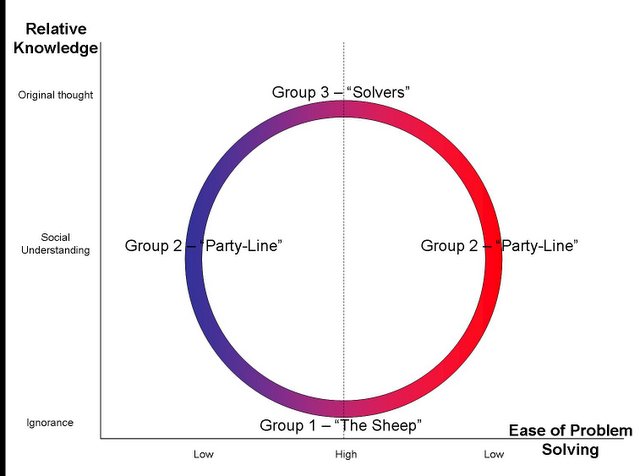
While I was taking this class, my dad and I came up with our own theory of knowledge. I call it the Circle of Knowledge (third cousin, twice removed, of the Circle of Life . . . not). This idea originated in a discussion of political topics, since that's my dad's main area of knowledge, but ever since I have noted that it seems to apply to almost everything I see it life. Gospel topics, literary criticism, history, you name it, it relates. We noted that for most divisive political issues, there appear to three types of people involved in debate, each with a different level of knowledge and relative stance on the issue. From our observations, we formed the following idea, which I have roughly sketched out below. (I apologize for the bad graphics. I don't have any cool photoshop programs.)

The Groups

  • Group 1 is the uniformed and apathetic, who are involved in the debate only in a figurative sense. They either don't care about the issue at hand or lack the information to form any strong opinion on the subject. Their main purpose is to serve as blind followers to be manipulated by group 2, or subjects to be educated by group 3. Thus, Group 1 is henceforth known as "the Sheep." All people in this group are just about the same with reference to the issue. One sheep is as good as another. Also, problem solving is easy with this group: it simply doesn't matter to them what you do, or if you do anything at all.
  • Group 2 consists of the moderately informed, at least on a social level. They know at least the general banter about the subject: slogans, catchphrases, buzzwords, the latest talk on CNN or Fox. As people begin to gather information, some of the people will form opinions which seem in total opposition to the opinions formed by others on the same information. In the case of a basic knowledge circle, there are two opinions, for ease of two-dimensional drawing, but with a little imagination, you can create a "circle" with 3, 4, or up to an infinite number of such opinions. (I guess you could even do a circle with one opinion, but I'm not sure of its relevance.) Group 2, or the "Party-Line," become convinced that their opinion is the only rational one, and refuse to hear anything to the contrary. You will find these people at all the national party conventions, as well as your local school board, and probably every college issue paper. Obviously, with these people it is impossible to get anything done because they cannot come to a concensus of action. They mostly just sit around yelling about how the other Party-Line is stupid and obviously can't tell black from white.
  • Group 3, of course, is the group you want to be in, but it also happens to be the smallest group. These are the people who push past the categorizing mindset of the Party-Line, and try to actually understand how rational people could come up with these two different views. Then, they add the missing ingredient in this problem: original thought (imagine that!). As they come to understand the other opinions available, the "Solvers" in group three reach the truth about an issue, not by valididating the opinion of any of the Party-Lines, but taking true principles from each and forging it into a new and brighter whole. They gain real understanding and knowledge, and when left to their own devices, can solve problems very effectively.

Of course, there are also any number of intermediaries between these groups. We progress in our knowledge around the circle as we study an issue, hopefully one day reaching the common ground at the top. Another idea which I have failed to include in my diagram is that of passion or ownership of an issue. The scale of passion about an issue runs about the same as the knowledge scale: the Sheep are apathetic, the Party-Line is interested, and the Solvers truly take the issue to be their own. This ownership, or maybe testimony, of an idea comes from the deep thought put in by someone in the Problem Solvers group, which forces them to really understand the significance of an issue. It is when we reach the top of the circle that we can really write something about an idea. Sheep simply don't know enough, and the Party-Line repeat old ideas with little new synthesis.

One of the main things I like about this system is that the difficulty of communication between groups can be illustrated by the distance between the groups on the circle. The two Party-Lines have as much difficulty talking to each other as the Solvers have trying to convince the apathetic Sheep. However, once you have reached the knowledge of the Party-Line, it becomes easier to make the jump into full Solver. Luckily, I believe we can train our ability to move up this circle at greater speed. As we train our mind to think more critically and to be in tune with the truth, we can rapidly ascend to the top, spending as little time as possible as the Party-Line.

Thoughts and comments are welcome. This idea is still much in development, so hit it with your best shot. As a brain starter, here's a few of the issues I have looked at using this pattern, most of which I am working towards a level 3 answer to:
  • Faith/Works

  • Pro-Choice/Pro-Life

  • Soulforce

  • Capitalism/Socialism

  • Post-Modernism/Critical Realism

Questions I am still working on:
  • What would a one-dimensional knowledge circle mean?
  • How could divine revelation/pathos/ethos/other methods of knowing complicate this picture?
  • Is it ever possible to skip from a Group 1 to Group 3?
  • What about backwards reversions?
  • Multiple, intertwined circles? (eg. Your level 3 is really a level 2 or 1 on a higher circle.) Can we ever reach a "last circle"?
Sweet! I feel like Yeats! :DPosted by Picasa