29 June 2006

Beauty and A Really Old (-Fashioned) Love Story

I am not usually the type of person for love stories. Perhaps because I have little (read: no) experience in them myself, they've always seemed far more fantastic and unrealistic than the sci-fi and fantasy I prefer. Also, I usually don't empathize very well with the heroines: either charming or naive, but always beautiful, none of which I have pretensions to. I've always defined myself based on a fairly gender-neutral intelligence. Pretty much, I think Jane Austen is boring, and my favorite chic flicks are IQ and You've Got Mail, mostly for Einstein and the witty construction (respectively) rather than the love story, which gets in the way for me.

Leave it to Orson Scott Card to write a romance that I could really enjoy. I'm only half-way through Rebekah, the second in his Women of Genesis series, and if there was anyone who could improve on the beauty of that story in the Old Testament, then it's the OSC. As a friend of mine said (John, this means you) Card is so amazing at understanding people that he makes you feel like a genius just to be witness to his analysis. In Card's religious fiction (Women of Genesis + Stone Tables), I have been continually impressed with his ability to flesh out these iconic figures into realistic characters while still remaining faithful to their place in the religious cannon. Without ruining the story for anyone who hasn't read it, Rebekah has shed much light in my mind on the issue of beauty.

He made me remember that for some beauty can be as much a curse as a blessing when looking for a relationship. (As Tevia would say, may God smite me with it, and may I never recover.) I had sort of realized this in the character of Lina in Sisterhood of the Traveling Pants--kitschy, I know, but true in feeling. Beauty--true beauty, and not just good grooming--is unlike almost any other trait in that it seems to happen almost as an accident, not being an essential part of a person's character. Rebekah's realization of her own beauty and subsequent panic were quite enlightening--I've never had the same worry that someone might want me not for myself but for some accident of birth.

Some will object that beauty is not so much looks as a way of behaving, and this is the other thing Card brings out. As Rebekah meets a particular woman for the first time, she is shocked to realize that though she is as beautiful as this woman, Rebekah has none of the grace, charm, and social skill necessary to really use this to full, feminine advantage. And so she sets out to learn and acquire the ability to make small-talk, flirt (such as it is in biblical times), etc. Until recently, I had mostly assumed that people were either just born with this grace or without: I had never really contemplated it as a skill to be acquired.

Now that I think about it, this is one skill that I could really use, considering my natural tendency is to be blunt or outspokenly passionate about everything. A little charm or grace could do a lot to mediate the bad effects of these two things. I've always avoided being too feminine, but maybe it's time to dabble in that area. I won't hesistate to say I feel quite silly though.

(Aside: I find it ironic that I finish this post while listening to "Astonishing," the song from the Little Women musical in which Jo's refuses Laurie's proposal. Pretty much the antithesis to the woman aspiring to marriage, and currently one of my favorite songs. Hmm.)

27 June 2006

The Real Independence Day: Primary Thoughts

IMAGE_043So I voted today in the primaries . . . did you? Probably not, considering only about 10% of Utahns actually vote in the primary. I find it fascinating that the same people that couldn't be bothered to vote today will next week be celebrating the ideals of our nation. It's fairly ridiculous that such a small percentage of the people actually care what happens in the primaries. In a politically lop-sided state like Utah, it seems that most elections would be pretty much decided in the primaries, since most Republican candidates are shoe-ins in November (with notable exceptions). You missed out on the real ceremony if you were waiting for the 4th to celebrate your American-ness.

And granted, some primary elections seem trivial: I don't understand the big hoopla over the Cannon/Jacobs race. The race is not over issues, since the candidates agree on almost everything. I mean really, the only argument in this race is whether experience is more productive than change. Why are people wasting all this campaign money to replace one representative with another who will do exactly the same things? Seems like a big waste of time to me. (Luckily for those of you who care, I am registered at home, not in the Bubble, so I didn't vote on this race anyway.)

Also, I was quite suprised at the ignorance shown by the candidates in the Jordan School District Prescint #3 race: two of the candidates didn't even bother to create websites, or ones that I could find anyway. You would think that in this tech-saavy world that would be a given. I did all my voting research online, and their lack of online information pretty much cost them my vote.

Oh, and if anyone out there was worried that electronic voting would be confusing, it's not. It is the most absolutely wonderful thing ever! Okay I exaggerate, but it definitely outranks punch cards--which even I found confusing--by a mile. And I say this not just from my tech-saavy perspective: my tech-backwards mother (sorry Mum!) was able to easily figure out the system. I enjoyed the large print option. Even though I didn't particularly need it, it was nice not to have to put my nose next to the ballot in order to read it. The only step that might be confusing is the double-confirmation of the ballot, since some people might forget the last step and just walk away. But the machine won't give you back your little ID card thing unless you do, so it should be fairly easy to spot and take care of.

25 June 2006

Pros and Cons of Being Martha

This wasn't what I originally intented to write about, but I need to write it down before I forget what it was about. So Saturday's intended blog entry is being put off indefinitely.

As this semester has come to a close, I've noticed a problem I have that's always been lurking in the back of my mind, but I never really bring out and conquer. It's one that should be obvious, but for some reason I manage to always ignore it. The problem is this: I am always living waiting for something to end, for the future, I guess, but mostly for change.

In particular, during the semester I tend to rationalize the fact that I have no time to do what I want by the fact that it will soon be over. This semester has really been the worst: I literally go to school everyday, come home, eat, do homework, and sleep. When I do have free time, I spend it vegging out in front of my computer because my brain and will are simply so fried that I can't do anything else. When the semester ends, I spend a few days just hibernating in my apartment recovering. But then, I don't learn from my experience and simply load myself up again with way more than I can handle.

I probably get this from my dad: he tends to go in this same full-throttle/crash-and burn cycle. He'll work a sixty hour week, perhaps staying at work for even 48 hours straight. Then he comes home and crashes through the weekend. I know this is not a good way to live; as I said to my dad, I don't want to live waiting for my life to be over.

So while I've been pondering this, I came across in my scripture reading the story of Mary and Martha in Luke 10. When people discuss this story, we talk about the problem of being too busy to stop and listen to the gospel. The work Martha is doing is something that needs to be done, but sometimes it is more important to stop and listen to the gospel. Mary is symbolic of the quiet listener, Martha the overworked and distracted disciple.

However, this time as I was reading this story, I looked up a cross reference and read in John 11 the story of Jesus raising Lazarus from the dead. I hadn't ever read this story focusing on the Mary/Martha aspect, but when I did, I noticed another aspect of this relationship which caused me to reconsider the meaning of the story. When Jesus comes to Bethany, Martha immediately comes to him, and when asked if she believes Christ has the power to raise the dead, she immediately says yes. But when Mary comes to the Lord, she seems, at least to me, to be in total despair, lacking the hope that Martha seems to have in the gospel.

The conclusion I came to was this: living a busy and less active life sometimes leaves little time to contemplate the gospel, but I think it gives us a testimony of the principles of the gospel in action in our lives. By sitting around contemplating the gospel, we can gain a deep understanding of the principles involved, but it doesn't necessarily give us a testimony of their truth. The gospel is not something that can be studied in isolation; we cannot learn the gospel without having something to apply it about. The most boring and least strong members of the church are those who spend all day studying the gospel. Really, it becomes a sort of inbreeding: you have no substance to live the gospel about and your belief in it becomes founded only on your study of it. But when you live, you see the application of the principles in your life, and your testimony grows stronger even though you may not have as much time to study.

So, as seems to be the conclusion of the most of my posts lately, it's all about balance. I need to find the point in my life when I won't be so overwhelmed that I don't have time to contemplate, but also be busy enough to have experiences and deepen my testimony of the gospel.

24 June 2006

Brittany McComb: A Question of Scale

Well, I had another blog topic for tonight, but after reading about Brittany McComb on Ben's blog, I guess I'll put off that post till tomorrow. It'll make a good Sunday post anyway.

So here's the short and fast story of Brittany McComb. Brittany becomes valedictorian. She writes a valediction about how Christ and God have changed her life. The administration, fearing legal ramifications, edits out of her speech all references to Christ and scripture. Girl tries to give original speech anyway, but the microphone is cut by the administration. Legal ramifications and talk shows ensue (see link above).

Now, keep reading, because I don't think I'm going to take the side you expect. In keeping with my Circle of Knowledge theory, I can see that each side in this debate has some truth behind it, and the conclusion I've come to seems to be somewhere in the middle. Keep in mind, I am not really interested in the legal aspects behind this, but the moral ones. After all, we can only have just laws if we truly understand the morals they should be upholding.

But the relationship between law and morality is another topic for another time. Back to the subject at hand.

Two opposing experiences keep coming back to me as I think about this issue of eliminating Christ from public. First, I remember sitting in my Theory of Knowledge class in high school listening to a girl explain how her belief in chakra energies and related religious concepts had healed her life, and were really much better than western medicine. Being from Utah, my high school did have quite a large percentage of LDS students (probably 50%), but since it was part of the IB program, it had a little more of an international flavor than most. This particular class I knew contained quite a few agnostics/atheists, several Jews, and at least one Hindu and one Muslim. But despite our apparent diversity and tolerance at other times, the feeling in the classroom was extremely uneasy, and the students in the class were clearly not comfortable with what she was saying to us. But none of us were willing to say anything about it.

I still wonder why we were uncomfortable. Was it the mere action of advocating a religious view in a classroom that made us uncomfortable, or was it that the philosophy being advocated? Had it been a Christian (or more particularly LDS) student speaking about Christ and the atonement, would we--by which I mostly mean I--have felt the same way? I know I have sometimes felt uncomfortable at the way other Christian religions proselyte. But if it were my own religion being preached to a crowd of essentially captive unbelievers, who hadn't asked to hear about it, would I feel the same way? Essentially, I think the delimma boils down to this: can we, or should we, separate the act of proselyting from the beliefs being proselyted? To this, I would hope I could say yes, that I could look at the act of proselyting from an objective point of view, even if it was my own religion. But this is something you may have to convince yourself of.

Once we admit this separation, and that proselyting can cause discomfort in an audience, we can see how there is some valid point for concern over public religious expression. It boils down to the same debate of the ages: individual rights versus public security. I mean, we have laws against verbal harassment for the same sort of reason: even though it does no physical harm, it can cause discomfort in other ways. In the same way, I hate being harassed by the protestors at General Conference or at the Manti Pagent. It is extremely disconcerting, even heartbreaking, to be forced to listen to your religion be thrashed and trashed, even indirectly by those who are simply preaching other views, in a place where it is not wanted.

Which leads me to the other experience I keep thinking about. This one I didn't experience personally, but did hear from a first-hand source. A German-language teacher at my school used to occasionally have a free reading period in class as a reward after quizzes or tests. However, when some students began to read their scriptures during that time, the teacher ordered them not to do so because it violated her freedom of religion. (In the end, she was not allowed to ban specific religious texts from the period, and instead decided to do away with it all together.)

I would hope that anyone reading that story would realize that what the teacher did was completely irrational. Having someone else read a certain book in your classroom is nearly impossible to rationally construe as a violation of your rights. Clearly there is a matter of degrees here. What Brittany McComb did is not on par with what the garment-waving protestors do at General Conference. A general scale of the relationship between religious practice and the public goes something like this, from most-easily acceptable to totally unacceptable:

  • private religious practice
  • public religious practice
  • expression of beliefs in public
  • proselytising and advocating a belief system
  • denigrating/descriminating against someone else's belief system
What the Brittany McComb incident represents is a confusion of this scale. Much of the civil rights movement worked hard to prevent the descrimination aspect of this scale, which I hope every rational person could agree is the right thing to do. And the Bill of Rights clearly protects the first two, the right to religious freedom. But what to do with these middle two is the problem.

I firmly believe that we do not live in a society that wants to eliminate expression of beliefs and proselytising all together. There may be some extremists who actually do believe that, but being an eternal optimist, I must believe that the majority are fairly reasonable people such as myself. The thing is that these reasonable people have noticed, as I have, that religious speech is a delicate issue, that at some times it is appropriate to voice belief and at others it is not. Even Christ said, "neither cast ye your pearls before swine" (Matt. 7:6), which I take to mean that we don't need to proselyte in every conversation (which bothers me to no end about some evangelicals), but we should instead reserve our expression to appropriate moments and audiences.

So in the end, after reading the full text of Brittany McComb's speech, I must agree with the school's decision to edit her speech. I disagree with the idea that there is no place for Christ in a graduation speech, but I think that the way she did so was not appropriate. Her speech focuses on her conversion to Christianity rather than her school experience. Her talk might actually fit in at an LDS testimony meeting, but not a graduation. Had she done as she claimed to have done and simply cited her religion as one of the influential factors in her life, in a quiet statement of belief rather than proselytizing, then the school board might have been in the wrong (morally, though perhaps not legally).

(However, after that, I must add that I do agree that this suppression of religion movement is targeted towards Christians. Notice in my two experiences that although there was discomfort in both, action was only taken in the situation involving a Christian religion. I however do not believe this to be due to a particular hatred of Christianity. Rather, it is due to two factors. First, other religions still fall under the protection of our fear of being accused of discrimination. We fear that our actions to preserve our own comfort will be miscontrued as racism or beliefism. Witness how the media deals with Islamic extremism--overly careful to make sure that the audience knows they are not against the religion, but merely some of its expressions. The second factor is simply the nature of Christianity. We are a missionary religion, and therefore we feel the need to speak about our beliefs more, which in turn gives us more opportunities to speak out in the wrong times and wrong places. Again, there may be some who do discriminate against Christianity, but not a majority, by far.)

22 June 2006

The "Same Old Thing"

Another post inspired by The Screwtape Letters. Sheesh, CS Lewis is such a genius. Anyway, on my way to school today, I was reading letter 25, in which Screwtape advises Wormwood on the use of the "Same Old Thing" philosophy to distract people from what they should be doing. Here's a description of this concept straight from the book (if you haven't read the book, note that this passage is written from the point-of-view of a devil, and thus the "Enemy" is God and the goal is to get man away from Him):

The horror of the Same Old Thing is one of the most valuable passions we have produed in the human heart--an endless source of heresies in religion, folly in counsel, infidelity in marriage, and inconstancy in friendship. . . . [T]he Enemy (being a hedonist at heart) has made change pleasurable to them, just as He has made eating pleasureable. But since He does not wish them to make change, any more than eating, an end in itself, He has balanced the love of change in them by a love of permanence. . . .

Now, just as we pick out and exaggerate the pleasure of eating to produce gluttony, so we pick out this natural pleasantness of change and twist it into a demand for absolute novelty. This demand is entirely our workmanship. . . . Only by our incessant efforts is the demand for infinite, or unrhythmical, change kept up.
I've personally been thinking about this problem a lot, both in the church as a whole and in my own life. A particular example of this problem which has been bothering me comes from a sacrament meeting in my ward. The subject of the meeting was to be on the resurrection, one of the most basic, beautiful, and essential doctrines of the gospel. The first speaker was from our student ward and the second was a high council speaker.

When the student got up, he started with the usual banter about being nervous, the bishopric calling him to speak, etc. But when he got to his topic, he said that he was supposed to speak about the resurrection, but that was a boring topic since everyone pretty much already understood that, so he decided to talk about a "personal resurrection" (his term for a change of heart) instead. I was first disappointed: I was really looking forward to hearing a talk about the hope afforded to us by the resurrection. But I decided to make the best of it and enjoy this talk anyway. Conversion and change, after all, is something we all need to work on. But as I was listening to the talk, I became even more annoyed and bewildered. Almost all of his talk came from self-help books, secular leaders, or popular sayings. When I started keeping count a few minutes in, I noted only one reference to Christ and possibly two scriptures or General Authority quotes.

To make matters worse, the High Council speaker had a similar problem: though he did sort of talk about the resurrection, there were even fewer quotes from General Authorities or scriptures in his talk. Instead, he spent the entire fifteen minutes listing a whole bunch of "faith-promoting rumors" about people who had survived near death experiences, and how this somehow proved that there was life after death, which sort of proved there was a resurrection, and wasn't that nice? The next week was fast Sunday, and my mind was probably still on this problem because all of the roommate-imonies, good-book-imonies, something-I-learned-in-class-imonies, and BYU-religion-department-imonies bothered me a lot more than usual.

It's a problem that seems to be unusually magnified at BYU, since we are surrounded by the gospel not only for 3 (more like 5) hours of meetings on Sunday, but in class, at home, at work. Theoretically, this should be a good thing: we are supposed to make the gospel a part of everything in our lives, like the foundation is to a house. But this massive exposure seems to have the side effect of causing some people to be "bored" with the gospel, bored of the same, simple "Sunday School" right answers--though the fact that such simple answers exist is, to me, one of the most joyous parts of the gospel. And when they are bored, they start looking for ways to make the doctrines of truth into new, novel concepts. (From this concept, we can infer the evolution of what is now the LDS publishing industry. Seriously, every time I walk into Deseret Book, I want to gag at the consumerism of it all.)

As much as I love CS Lewis and other inspiring figures, the main focus of our meetings should be on the basic doctrines of the gospel as taught by the scriptures, General Authorities, and the Spirit, no matter how long we have been in the church. Yes, I realize that the GA's occasionally quote world leaders, CS Lewis, and even Fiddler on the Roof. I have two answers to this: first, they tend to do so in moderation, spending the majority of their talks on scriptures and personal testimony; second, they are GA's, so they have a greater ability to discern truth out of these non-cannonical sources than your average church member.

What I mean is, we should be teaching out of sources that are "safe." When you are dealing with your own spiritual growth, sure, seek learning out of the best books, and the spirit will guide you to discern the truth. But when it comes to teaching others, what the spirit uses to teach you may not be what they need. So stick to the basic sources recommended to all members of the church. Don't make your home teaching thought a quote by Nelson Mandela. Yes, this happened to me. Innovative as it was, I would have much preferred one from the Ensign, or the scriptures.

My personal way to make sure that I stay on the the strait and narrow in my teaching is the SQRT formula: for every concept I want to teach, I look for a personal Story, a GA Quote, a scripture Reference, and give my personal Testimony. This keeps it simple and doctrinal, and keeps me from teaching out of the Book of Liz to those who don't need it or aren't ready for it.

No, the doctrines of the gospel are not new concepts, but why should they be? People through out all ages of history face basically the same problems, and the Lord doesn't need to invent new answers to problems He has already given us the answers to. Give me a meeting where we "preach nothing save it were repentance and faith on the Lord, who had redeemed his people" (Mosiah 18:20). Every time we are called upon to give us lesson, let us put it to the test of 2 Nephi 25:26:
And we talk of Christ, we rejoice in Christ, we preach of Christ, we prophesy of Christ, and we write according to our prophecies, that our children may know to what source they may look for a remission of their sins.

12 June 2006

Crimes of Passion: A Geek Manifesto (of sorts)

So, I took the Geek Test, scoring a delightful 27.7%. (Miserable compared to my Harry Potter Obsession score, though the quiz is slightly outdated. . . . I think I get bonus geek points for actually thinking about rewriting that test.) And oddly I am only ashamed that my geek score is not higher.

Why do I enjoy being a geek? Actually, the question is why is being a geek so out of fashion? In my modernism class, we talked about our society's obsession with entertainment. One of the most important qualities we look for in people is if they are funny (ie entertaining), and the insult that can stop anything flat is "boring."

And yet, we also strangely avoid all semblance of being entertained by anything. Oh sure, you can say you enjoyed a movie, or like a particular song. But if you go much further than that, express any real enthusiasm for anything, much less anything academic, and you are labeled a fanatic (from which we get 'fan'), nerd, perhaps narrow in your interests. In other words, a geek. Really, the word geek encompasses so many interests--science, math, games, literature, music, history, philosophy, movies, theater, band, choir, books, sports--that it has come to mean anyone an abnormally large passion for anything.

And we scorn geeks.

Thus, our society has come to laugh at people who care. This can't be a healthy thing. Though some people might call geekhood an "unhealthy obsession," I certainly think over-indulging in the things you enjoy is much better than this repression of passion that we have in modern society. At least geeks are willing to admit that they care about something, and to follow through with the things they care about. They are willing to be happy, and not because of the big things either. We don't have to wait to get perfect grades, a huge raise, a trip to Hawaii, and perfect relationship to enjoy life. Geeks can enjoy themselves by learning a new word, figuring out that physics formula, watching a new TV show, getting a new RSS feed, or playing dress-up for-goodness-sake! Why does the modern world insist on being so hard to please, when happiness can be found in all these small things that geeks see everyday!

Which brings me to the centerpiece of this blog entry, which I found the other day and made me feel immensely satisfied, especially considering recent posts. I found out about this geek dating website, Geek2Geek, (not of my own accord--it was advertised on PotterCast . . . oh, never mind) built for the express purpose of getting geeks together. Now, I'm not advocating internet dating here. I bring up this website because of this list:

Top 10 Reasons Why Geeks Make the Best Catch

It’s not generally realized that geeks (male and female) are the best catches. Americans focus on the glamor of the good-looking, the male jock and the statuesque female, and tend to make fun of second banana characters like Urkel. Yet, geeks (a.k.a. nerds, etc.) provide the opportunity to have much longer, more stable, and happy relationships. Here are the top ten reasons:

1. Geeks don't cheat. Geeks know that the grass only seems greener on the other side. They instinctively stay devotedly loyal to their lovers through thick and thin. Their social skills are also not well developed enough to support an affair.

2. Geeks appreciate their mates. Since you are likely to be one of the first persons a geek has ever had a significant relationship with, you will be treated well. A geek knows that there aren’t a whole lot of other possibilities. Frankly, geeks aren't quite sure how they ended up with the person they have attracted. When you date a geek, you know that geek will be yours for as long as you wish.

3. Geeks haven't formed bad relationship habits. After years of dating other people, the socially successful have become too confident to be intimate, think of partners as being only for their self-gratification, and focus on making themselves happy. None of this is true of a geek. The lack of past romantic partners allows the geek to approach lovers with the zest of a neophyte. Geeks are not full of romantic confidence. However, once encouraged, they are eager to please and enjoy their relationship.

4. Geeks are good at the things they try. Every geek has skills passionately developed over a long period of time. It could be role playing, chess, hacking, playing video games, or the ability to properly assemble a computer. So you know that geeks won't quit until they have learned how to make their relationship the best.

5. Geeks are not interested in status. Geeks became geeks because they chose to spend their time doing things that would not necessarily make them popular with everyone else in school, like sports and fashion. The ability to resist peer pressure is important to geeks. This means that a geek is more interested in your happiness than in looking good to others.

6. Geeks have imagination. Boredom is important to avoid to the game playing geek. A geek will seek new and creative ways to play, and this translates to relationships as well.

7. Geeks are happy and successful in their chosen field. No matter what their education level, geeks are able to make good incomes doing work that they enjoy. That eliminates one of the most frequent causes of relationship problems, since people who don’t like their jobs may take it out on their significant other.

8. Geeks are analytical. If they don’t get it right the first time, they look at what they did and figure out what to change. And when they DO get it right, they still keep finding ways to improve on it.

9. Geeks can concentrate. Geeks can focus their energy on one task with total intensity. Granted, the task they are focusing on may have more to do with writing new software for their Blackberry, but the fact remains that a geek, once set upon a task, tirelessly sets about to achieving a goal.

All of which means that…

10. Geeks want to be the best at what they do. So they try harder. And they never stop trying.


Amen to that. This list can really apply to anything geeks do. In summary, geekhood may not be the only path to happiness, but it certainly is one that works. Geeks have the power. Embrace your inner geek.

(If you need somewhere to start, you should check out Avant Game, which was recently highlighted on Blogger's Top 10 List. This whole pervasive gaming idea is awesome! I've been doing some geek-like exploring of the genre, and found several really cool ideas. If you'd like to get started on alternate-reality gaming, try one player games like Planetarium or Conspiracy, go in deep with EDOCLaundry, or start out small with this riddle game (I'm still stuck on #1).

Anyone for Tombstone poker? I'd have to learn poker first, or modify it for another card game, but it might be worth it.)

Seriously, be a geek. You will feel better.

09 June 2006

a little fall of rain, a house of grace

"I" goes out with the smell of rain,
the skin shed from a snake
exposing a new layer

i see
Angel rings
Ripples
in the pool.

if only I could be--

fastest rising highest
That I might be healed

Ripples fall
faster and faster
i have no chance
can't get, run, catch,
already too late to begin

So many ripples
but not for me

alone.
no ripples--
yet surrounded

could there be rain,
make flowers grow
inside the withered soul?

false expectation,
over-played;
under-interest,
disgust & fatigue
setting myself up.

There could be rain,
it is waiting

i see it waiting
but I am hiding
Afraid of finding what I seek.

After Poem Wind-Down, in Prose

Funny how sometimes when you think you know just the right person to cheer you up or help you out, the universe sends the exactly wrong person. But today, he ended up being the right person because he made me realize all that I am not. I am not hopeless, clueless, or alone. That I do have skills, that I could be likeable, that there is hope for joy.

And I know the answer to my poem is in What the Thunder Said. But how does one get there from the Wasteland? (Sorry for the literary reference, but if you haven't read it, you should. And then you should talk about it with someone who has, or it won't mean anything.) My life is so centered on being lost, different, and alone that it's difficult to see the pathway to being part of something. I seem to have an idea of the bridge, in which I'm sure Christ is involved, but the path is still hazy to me.

Perhaps this all comes about from reading the Screwtape Letters. Or it's another factor anyway. I know, I should hardly dare to put CS Lewis on my interests list if I haven't read it before, but there's a first time for anything. But that part about keeping our beliefs in the theoretical, thinking it is enough to simply think about action, and allowing that to lead us to complacency, that hit to my core. That's me--living in the world of my ideals.

A sign on a professor's door in the Benson building reads:

Theoretically, there's no difference between theory and practice.
Practically, there is.
And that sums up my problem: I know a lot about people and relationships theoretically, but practically is another matter. I am not good at risking myself, trying, caring, being there. And I feel I should be, despite the fact that I have never done so. As a child, I never played games until I was sure I could win (which probably explains my aversion to sports). That continues to today. I have never actually played Risk, but I have watched it so many times. Video games, same deal: I've seen them all, played none. Never played DDR, but I like the idea of it. Ultimate Frisbee, definitely not at all. And relationships, where it's not a game, are much worse. How can I possibly learn how to win before I start?

In order for me to ever find what I seek, I must be willing to "take chances, make mistakes, and get messy." But I am not. I need to find a way to be able to. I could try locking myself off, but clearly that's not something I would do. I try to keep my self at the surface, but as a result I have to be very cautious or I can break. Do break, actually, but we try to keep the damage down.

07 June 2006

Growing Together

Sort of a follow-up to my "Weary of Well-Speaking" post: As I said in the comments, one of the reasons I am irritated by debaters is they are taught to win arguments, not to search for truth. The more I think about it, the more I see the reoccurance of this problem in society. Aside from the obvious example of politicians, I am specifically thinking about this principle as it applies to marriage and other personal relationships. At institute tonight (the Marriage and Family series--no great wonder), we discussed at length the yoke metaphor used by the Savior in Matthew 11:28-30:

28 ¶Come unto me, all ye that labour and are heavy laden, and I will give you rest.

29 Take my yoke upon you, and learn of me; for I am meek and lowly in heart: and ye shall find rest unto your souls.

30 For my yoke is easy, and my burden is light.
One implication of the metaphor struck me as particularly relevant to what I've been trying to get at recently: If one ox in a yolk pushes too strongly for his own way, rather than following the Lord's way, not only does the team deviate from the path, but they can end up going in circles. When we fight too hard for our own ideas and decisions, it is often at the expense of progress, change, and growth. If instead we are meek about our own ideas and work with the Lord, He will guide our progress in the desired direction.

Of course, this analogy translates not only to our relationship with the Lord, or to a relationship with a future spouse, but really to any relationship in our lives, including parents, roommates, siblings, and friends. Really, the point where we seem to get into trouble in a relationship is where we want things "my way" without bothering to understand the possibility of an "our way." Talking escalates to contention when we set as our ground rule that we are right.

In most arguments of my experience, the phrase "Listen to me" or "Are you listening?" or some variant usually comes up. Well, that's a silly question. If you weren't listening, there wouldn't be an argument going on. What they really mean to ask is "What you are listening for?" Are you listening merely to catch the weak points of their position, so best to plan your next attack when they finally finish, and, assuming they ever stop spouting such utter nonsense, you'll set them straight on the facts? Or are you listening with understanding, to truly comprehend what has led to your differences in position, to find the common ground, the truth behind the conflict? When we are seeking for a good solution for both parties, arguments dissolve into discussions, contention into compromise, confusion into construction.

It's similar to the idea behind my Circle Theory and Habit #4 of Covey's Seven Habits. The secret behind both greater intelligence and more successful relationships is the same: learning to think of opposing views not as the enemy, but as a partner, realizing that compromising can be growth instead of loss. When instead of attacking our political opponents, we sit down with them, get to know the beliefs behind their views; when instead of becoming frustrated with our parent's pushy-ness or old-fashioned-ideas, we understand their motivations and principles; when we not only understand others' beliefs, but come to believe them as well, it is then that the true growth starts.

If we continue to divide humanity into smaller and smaller groups according to who agrees with us, we will end up with nothing. But when we seek to include others, and most importantly the Lord, in our search for right, our ability to grow together borders on the infinite. Division is only necessary for definition of problems, not for truth. Once we have divided, it is our duty to once again build and grow together. If we are not one, well, you know. . . .

02 June 2006

The New Development is Orange with Bunny Ears

I just found out about the One Laptop per Child project on Slashdot. An excellent summary of the latest model can be found here. The basic concept is to make a cheap, highly functional, low-end laptop to be purchased in bulk by governments for use in schools, particularly in third world countries. For countries without a power grid, some sort of human power generator (foot pump, or hand crank maybe) would be provided. These laptops will perform all the basic functions of our "obese" laptops, except for massive data storage. Besides basic word processing and internet capability, built-in functions include wireless access, the ability to easily form ad hoc networks, microphones and speakers for chat and music, a tablet-PC-like mode, and durability. At a price of about $100 each, schools might soon be able to afford to check out laptops to students each year. Plus, it looks so cool: orange with bunny ears indeed.

Some may wonder why people are even concerned with access to laptops in countries where basic needs are not always met. I actually think that this is one of the best things for development that I have seen in years. I wrote a topic booklet for RHSMUN a while back on this very subject: access to modern technology is often better at increasing a country's development status than direct efforts. According to the World Bank's 1998/1999 World Development Report, the countries that saw massive increases in development status from the 70's to the 90's (Singapore, Korea, and other Asian nations) focused on their population's acquisition, education, and production of modern technology.

In other words, it is a huge mistake to think that a country must pass through all previous technological states before arriving at modernity, that once they address basic needs they will catch-up. One of the new buzz words in development is "leap-frogging": with the invention of wireless technologies, many less developed nations can skip over the expensive infrastructure of analog and go straight to wireless. By getting modern technology into the hands of the children in these countries, we greatly increase their earning power in the modern world, and thus their ability to help their country grow. It's the "teach a man to fish" philosophy in action! It feels so completely empowering.

Or perhaps this project simply appeals to me because the idea of each student having a laptop reminds me a lot of the "desks" in Ender's Game. :D

01 June 2006

Weary of Well Speaking

I have a terrible bias against good public speakers. Here are some possible reasons for this:

  • Perhaps this is because I am not one. My presentation tends to be terrible, given that I tend to cry when I am nervous or discuss anything I care about. People who can remain unemotional when discussing something important lack passion or conviction in my eyes.
  • To me, good speaking tends to indicate a lack of substantial ideas, glossed over with flowery language and anecdotes. Unlike much of the international community, I actually find comfort in the fact that President Bush is a terrible speaker, because it indicates to me he is sincere in his thoughts, elected for his ideas, not for his charm. One of the main reasons I would never have voted for Kerry was his speaking ability: smooth, eloquent, and able to speak about nothing for hours. Very typical of the modern career politician, and in my view, the main enemy of progress in government. Politics (and by extension, life) seem to be so much about how you say things and who you are, rather than the actual ideas you have. Rather than consisting of plans and positions, so much of any speech is just vague filler statements, the kind that I would slash through with my red pen if it were an essay.
  • Debaters. Bad experiences with debaters. Something seems so wrong to me with the idea of debate competitions. We teach students to argue either side of an issue, as if your personal convictions, or actually truths, about right and wrong are not really that relevant. They are taught to cut into flaws in evidence and presentation, undermining their opponents not by superiority of ideas but by seeming technicalities. They ignore, or cover up, the valid points of their opponent, pitting the worst of their opposition against the best of their own thought. This seems to me a short, sloppy, and least-effective method of argumentation. If you really want to prove something true, you must take your opponents' best arguments, rather than their worst, and you must acknowledge the weaknesses of your position. Only if you can convince someone in spite of both of these things have you truly found truth.
Does anyone else feel this way?

21 May 2006

Illegal Immigration: A Necessary Part of the American Economy?

Illegal labor has become the backbone of many businesses in America, particularly for agriculture, restaurants, construction, and many service industries, providing low cost labor that reduces consumer prices and increases profit. That may all change with the introduction of Bill HR 4437, which passed in the House last December and is currently being debated by the Senate. Titled the “Border Protection, Antiterrorism, and Illegal Immigration Control Act of 2005”, this bill would enact a mandatory “employment eligibility verification system” to be in place in the next six years. Employers still using illegal alien labor after that time are subject to a fine up to $50,000 for each worker and possibly one year of imprisonment (H.R. 4437, 2006, Title VII: Employment Eligibility Verification).

These extremely harsh penalties and forced conversion to legal workers have many employers worrying about the feasibility of a complete switch of their labor force in the next six years. With many industries so dependent on illegal labor, they wonder if there are enough American workers to replace an estimated 9-12 million illegal aliens. Business owners say they can not find legal workers to do these jobs, many of which are undesirable, hard labor positions. Even if a replacement labor force exists, many companies may not be able to afford the drastic increase in wages necessitated by hiring at minimum wage and providing benefits. The increased costs of labor will have to be passed on to consumers, perhaps causing dramatic price hikes for basic necessities like food. Businesses worry that consumers will be unwilling to pay the increased prices, resulting in serious damage to American businesses. These business owners claim that America depends on the cheap labor provided by illegal immigrants and that a conversion is economically impossible.

According to a study by Thomas J. Carter, a member of the Department of Economics at the University of Florida, illegal workers affect the labor market in two ways. First, illegal workers take jobs that legal workers won’t take, exactly as business owners claim (Carter, 2005, 777). In these sectors, a continual flow of new migrant workers creates a surplus of labor that keeps wages low and allows business owners to increase their profit margins. However, there is a second effect of illegal labor that employers generally ignore: as the number of available workers increases, as it has for the past few decades, industries who used to employ legal workers turn to undocumented workers in order to cut costs (Carter, 2005, 777). Because migrant workers are willing to work for much less than American workers, legal employees become unable to compete for these jobs and are gradually phased out in favor of cost-cutting immigrant labor. Over time, this second effect leads to the first effect: a labor market dominated by illegal labor taking jobs that Americans “don’t want.”

However, it is important to remember that at one point Americans were happy doing these jobs because they provided wages that could support a decent living. These jobs only became undesirable when employers lowered their wages because there was a labor market willing to accept them. This transition can be seen in the many industries currently undergoing the switch to illegal immigration. Take for example the construction industry, in particular, David Shafer, the latest in a family of house framers in Suwanee, Georgia (Feagans, 2006). In the heyday of his business, Shafer had managed to earn over $100,000 a year, a more than decent living by any standard, and owned a vacation home by the lake (Feagans, 2006, Family of framers section, para. 6). The workers on his crew also earned a decent wage, $15-20 per hour, but now Shafer’s company is unable to get any work contracts because of cheap, illegal labor, and “many of his crew members eventually switched to commercial construction or left the business altogether, unwilling to work for such low wages” (Feagan, 2006, Bids weren’t that close section, para. 3). Shafer said, "I can't get a job because these guys work so cheap. . . . I'm going to have to sell a coin collection to buy my wife a Christmas present" (Feagan, 2006, para. 5). The same thing that is happening to Shafer’s construction industry is happening to other jobs all over the country. Jobs that were once respectable have become jobs that Americans “won’t do.” However, we should remember that only a few years ago, Americans like David Shafer and his crew were doing these jobs, but they just can’t or won’t do it for the wage demanded by the illegal labor market. When the labor market is again deprived of this inexpensive labor source, and wages go up, these Americans will mostly likely return to doing the jobs they have done in the past.

But how can increasing the cost of labor be good for American businesses? Won’t the resulting increase in consumer prices cause a large economic collapse? First, remember that increasing wages works on both sides of the argument. It increases consumer prices, but it also raises the spendable wages of the group least able to afford current prices. Indeed, the lower-middle class and poverty classes, the ones who would be most damaged by a price increase, are also those whose improved wages caused the price increase.

Compared to the increased take-home pay for the lower classes, the price increases might not be as harmful as some might think. While statistics on possible price increases due to loss of cheap illegal labor vary widely (from $.19 per head of lettuce to $5.00), a worse-case scenario thought experiment on the subject can give us an indication of the possible effects of using legal labor. Even if an employer is forced to raise wages for agricultural workers by the high amount of $10.00/hr and assuming that worker to only be able to pick 50 heads of lettuce per hour, the increased cost per head of lettuce picked by that worker is only about 20 cents a head. If we add on an increase of pay at packaging plants and grocery stores, it is conceivable that the total price increase might be around $1-2. However, this same full time worker who is purchasing that lettuce would now be making around $400 more every week. Even if the worker’s total weekly grocery costs increase by $100, the increase in take-home pay of workers seems to still be significant enough to allow workers to increase their spending, which could then be passed on to the farm owners, who might stand to actually make money due to an increase in spending.

In general, the upper-middle class will not be as drastically affected by a possible increase in grocery and service prices as some believe. In fact, America’s grocery costs are currently much lower than for similar developed countries. According to an unpublished study by the US Agricultural Department, “Americans spend less on food than the citizens of any other industrialized country” (Katel, 2005, Overview section, para. 31). Specifically, the Encyclopedia

Britannica says that American households spend 7.9% of their income on food in the home, much less than Germany (13.90%), France (14.7%), the United Kingdom (16%), or Japan (23.3%). An increase in grocery prices would simply bring the United States closer to the standard of the world market. The average income in these countries is similar to that of the United States. If their middle and upper classes can afford to pay more for groceries, there is good reason to believe that Americans would be able to do the same.

In the short term view, the switch away from illegal labor may cause some financial problems for businesses as Americans adjust to a new price scale, but these problems are not permanent, devastating, or unsolvable. In the six year transition period, a worker shortage is possible, but there is no evidence that American workers will refuse these jobs, once the wages are brought up to a decent standard. Indeed, workers in industries that are only just experiencing the conversion to illegal labor, like house framer David Shafer, would gladly take their old jobs back. Though wage increases may make a large initial impact on businesses that have been using illegal labor longer, the increased spending capability of their workers will eventually be beneficial to their business and the American economy. Prices will increase across the board, but so will Americans ability to afford them. There is time over the next six years for American businesses to prepare for and survive the transition to a legal labor market, ending America’s dependence on cheap but illegitimate labor.

16 May 2006

Why I Enjoy the Da Vinci Code

In the days leading up to the release of the Da Vinci Code movie, I have been enjoying the opportunity to discuss this book with the people around me. (I missed the first wave of discussion since I was one of the last people I knew to read the book.) So far, I've seen two main arguments as to why people didn't like the book:

  1. Historical Inaccuracy/Improbability - Lots of people complain about the history in this book being just plain bad. I mean, overall, it's not good history: ancient texts taken with much more certainty than they can possibly be given, jumping to conclusions based on only a lack of evidence. Not even to mention that Catholics everywhere are mortally offended by the implications. (Of course, I haven't met any of those, but it must be mentioned.)

  2. Poor Writing/Predictability - Basically, all Dan Brown books are the same. You think you know the way the world works, but just wait! There's this giant conspiracy run by the people you thought you could trust, and if they are allowed to succeed it could revolutionize the world (for good or ill). Additionally, chapters are artificially terminated to enhance suspense, the characters are flat and static, and the quality of the puzzles is uneven at best. (I managed to guess the answer to the crucial puzzle in both Da Vinci Code and Digital Fortress shortly after they were discovered, which sort of ruins the suspense for the next half of the book.)
Somehow, neither of these things are a problem for me. As infinite numbers of people have pointed out, complaint #1 is sort of silly: this book is fiction. The claim at the front about all the information being correct is a classic ghost-story/Scarlet Letter claim: it enhances the stakes of the story by insisting that it is all true. But underneath all that, no one really believes in magical 'A' shaped comets or in campfire ghosts. The claim is put there to help the reader suspend disbelief, not to make them actually believe the story is true.

The way to deal with claim #2 is less obvious. I mean, what is a story besides good writing? On the contrary, many of the "classic" books have poor writing. Tolkien, Dickens, and Dostoyevsky are long-winded (Please don't attack me! I like . . . well, at least Dostoyevsky.), CS Lewis' Penvensie children are flat characters to the core, and Herman Melville can't stop rambling out on tangents. We overlook some faults in writing because of the quality of the ideas and intent behind them.

Which brings me to the reason that I enjoyed The Da Vinci Code. The topic was original--at least, I still have never read anything like it. It dealt seriously with divinity, religion, and gender issues, though admittedly very incompletely. It set me thinking about new ideas and things which I never would have even given a second thought. Admittedly, I disagreed with many of the main premises of the book--being married does not cancel out the possibilty of divinity--but the thoughts it led me on could still have significant meaning. But before this, I had given up on modern portrays of religion in fiction: either you are anti-religion (which paints all organized churches as corrupt organizations, and all truly good people as merely spiritual--think His Dark Materials) or you are rabidly religious (think all Mormon novels--the characters are perfectly righteous except for a minor flaw, all doctrines of the gospel are assumed to be standard, and, almost without exception, the prodigal sons return eventually or die miserably). Very few books deal with religion and truth as a serious issue, and this is one of them. (The Women of Genesis novels and Stone Tables by Orson Scott Card have come close, though.) It felt so liberating to have a book which actually looked at this issue that I was willing to overlook almost any number of faults to enjoy it.

Who cares if it follows a formula? One could say the same about Sherlock Holmes, but we still read him today. Sometimes we like a good formula fiction. Like writing a sonnet, strict, predictable form can liberate content.

Oh shoot. I just compared sonnets to formula fiction. The English Deparment secret police will be knocking on my door any second.

14 May 2006

The Circle: A Theory of Knowledge

When I was in the IB program in high school, we were required to take a very interesting class called "Theory of Knowledge." The actual content of the course included basically life, the universe, and everything. More specifically, we talked a lot about how people know things, what truth is, valid methods of persuasion, etc. It was basically a crash course in philosophy, writing, and debate, only a lot cooler because Mr. Campbell taught it. (He has subwoofers under his desks and reads The Simarillion once a year. Yeah, he's cool.)

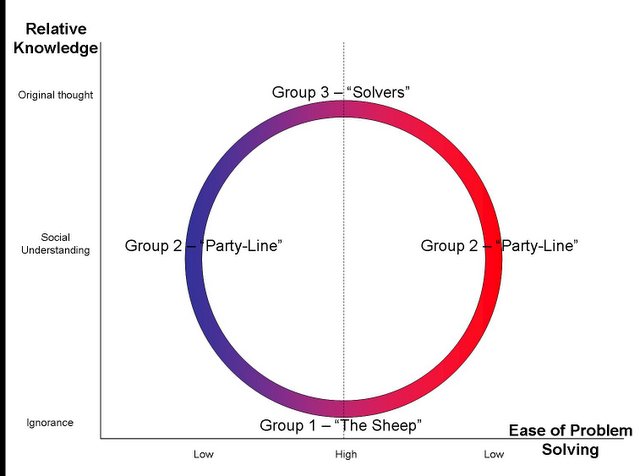
While I was taking this class, my dad and I came up with our own theory of knowledge. I call it the Circle of Knowledge (third cousin, twice removed, of the Circle of Life . . . not). This idea originated in a discussion of political topics, since that's my dad's main area of knowledge, but ever since I have noted that it seems to apply to almost everything I see it life. Gospel topics, literary criticism, history, you name it, it relates. We noted that for most divisive political issues, there appear to three types of people involved in debate, each with a different level of knowledge and relative stance on the issue. From our observations, we formed the following idea, which I have roughly sketched out below. (I apologize for the bad graphics. I don't have any cool photoshop programs.)

The Groups

  • Group 1 is the uniformed and apathetic, who are involved in the debate only in a figurative sense. They either don't care about the issue at hand or lack the information to form any strong opinion on the subject. Their main purpose is to serve as blind followers to be manipulated by group 2, or subjects to be educated by group 3. Thus, Group 1 is henceforth known as "the Sheep." All people in this group are just about the same with reference to the issue. One sheep is as good as another. Also, problem solving is easy with this group: it simply doesn't matter to them what you do, or if you do anything at all.
  • Group 2 consists of the moderately informed, at least on a social level. They know at least the general banter about the subject: slogans, catchphrases, buzzwords, the latest talk on CNN or Fox. As people begin to gather information, some of the people will form opinions which seem in total opposition to the opinions formed by others on the same information. In the case of a basic knowledge circle, there are two opinions, for ease of two-dimensional drawing, but with a little imagination, you can create a "circle" with 3, 4, or up to an infinite number of such opinions. (I guess you could even do a circle with one opinion, but I'm not sure of its relevance.) Group 2, or the "Party-Line," become convinced that their opinion is the only rational one, and refuse to hear anything to the contrary. You will find these people at all the national party conventions, as well as your local school board, and probably every college issue paper. Obviously, with these people it is impossible to get anything done because they cannot come to a concensus of action. They mostly just sit around yelling about how the other Party-Line is stupid and obviously can't tell black from white.
  • Group 3, of course, is the group you want to be in, but it also happens to be the smallest group. These are the people who push past the categorizing mindset of the Party-Line, and try to actually understand how rational people could come up with these two different views. Then, they add the missing ingredient in this problem: original thought (imagine that!). As they come to understand the other opinions available, the "Solvers" in group three reach the truth about an issue, not by valididating the opinion of any of the Party-Lines, but taking true principles from each and forging it into a new and brighter whole. They gain real understanding and knowledge, and when left to their own devices, can solve problems very effectively.

Of course, there are also any number of intermediaries between these groups. We progress in our knowledge around the circle as we study an issue, hopefully one day reaching the common ground at the top. Another idea which I have failed to include in my diagram is that of passion or ownership of an issue. The scale of passion about an issue runs about the same as the knowledge scale: the Sheep are apathetic, the Party-Line is interested, and the Solvers truly take the issue to be their own. This ownership, or maybe testimony, of an idea comes from the deep thought put in by someone in the Problem Solvers group, which forces them to really understand the significance of an issue. It is when we reach the top of the circle that we can really write something about an idea. Sheep simply don't know enough, and the Party-Line repeat old ideas with little new synthesis.

One of the main things I like about this system is that the difficulty of communication between groups can be illustrated by the distance between the groups on the circle. The two Party-Lines have as much difficulty talking to each other as the Solvers have trying to convince the apathetic Sheep. However, once you have reached the knowledge of the Party-Line, it becomes easier to make the jump into full Solver. Luckily, I believe we can train our ability to move up this circle at greater speed. As we train our mind to think more critically and to be in tune with the truth, we can rapidly ascend to the top, spending as little time as possible as the Party-Line.

Thoughts and comments are welcome. This idea is still much in development, so hit it with your best shot. As a brain starter, here's a few of the issues I have looked at using this pattern, most of which I am working towards a level 3 answer to:
  • Faith/Works

  • Pro-Choice/Pro-Life

  • Soulforce

  • Capitalism/Socialism

  • Post-Modernism/Critical Realism

Questions I am still working on:
  • What would a one-dimensional knowledge circle mean?
  • How could divine revelation/pathos/ethos/other methods of knowing complicate this picture?
  • Is it ever possible to skip from a Group 1 to Group 3?
  • What about backwards reversions?
  • Multiple, intertwined circles? (eg. Your level 3 is really a level 2 or 1 on a higher circle.) Can we ever reach a "last circle"?
Sweet! I feel like Yeats! :DPosted by Picasa

02 May 2006

On Education and Knitting

Some notes from my English 363 reading, both of which are irrelevant to the class, so I thought I'd rant them here. For reference, here's the reading assignment:
The Dynamo and the Virgin - Henry Adams
Venus Transiens - Amy Lowell
Roman Fever - Edith Wharton
A Life Apart - Edith Wharton

"Nothing in education is so astonishing as the amount of ignorance it accumulates in the form of inert facts." - Henry Adams

I thought that the Henry Adams piece was very interesting. His statements on education seemed very perceptive. So much of modern education focuses on accumulation of fact, partially because we generate so much knowledge every second that it is overwhelming. There are so many facts that we need to learn that there is no time to sit and talk about what they mean. I think particularly of high school. People are taught to regurgitate facts so they can get the right answer on a multiple choice test or spew them out into a list-of-facts "essay." It's an age of information bulimia, so to speak: we read and read, injesting masses of information, but once the final is over, we throw it all back up, taking little if any important nutrients from the facts to feed our starving minds.

Any digestion of the facts into comprehension, enlightenment, and understanding is left up to the student without the aid or encouragement of the educator. It seems we've decided that it isn't fair to grade students on intellegent thought, only completion of materials. We want to only test them on what the class has taught them. We fear testing students on their actual abilities. Witness the outrage of 4.0 students who score poorly on the SAT because they "can't take tests." What they mean is that they can't take tests that test their ability to think instead of their ability to repeat information. In my personal experience, SAT/ACT are a really good predictor, not of a person's success in school, but of their ability to come up with independent thought. (Most unfortunate that the two don't correlate.)

Whatever happened to demanding essays, research, thought? In high school, it was a rare class in which we wrote an essay which demanded any outside research or thought to write an "A" essay. Simply repeat what you were taught in class coherently with decent grammar and *poof* get a great score. I imagine outside of my honors-track world, it might be much worse. I think more essays need to be present in school. We need teachers who will teach children how to think or, more importantly, how to convey their thoughts to an audience when they write. Teachers seem to shy away from essays, mostly because students complain about them (a lot) or because of the grading workload. But hard work or unpleasantness do not mean that these things are not extremely important.

And now for something completely different and much shorter . . .

"'And you see—' Half guiltily she drew from her handsomely mounted black handbag a twist of crimson silk run through by two fine knitting needles. 'One never knows,' she murmured. 'The new system has certainly given us a good deal of time to kill;'" - Edith Wharton (Roman Fever)

Interesting how knitting is portrayed in fiction. I never noticed this before until 1) I became a knitter and 2) I started knitting in my English classes. Now whenever we come accross a passage about knitting, people stare at me until the teacher notices. Anyway, I think I might like to write a paper on knitting in modern literature sometime. I might have to broaden it out to all sewing arts, but still, there's some interesting stuff. In Heart of Darkness, Conrad's nod to the fates is through two old women knitting at the office in Belgium (? I can't remember), which to me tips knitting as a sinister and mysterious practice. There was one other text in my Brit Lit class about it, but now I can't remember. In this Edith Wharton story, knitting is a sort of "opiate of the masses," assuming that by the masses I mean the upper class. It's a sort of anesthetic to keep you from noticing how truly pointless your life is by giving you something harmless and seemingly productive. Interesting.

I could see how this might be true in my own life. I do tend to knit when I am stressed, nervous, or bored. I should really write this thing. Anyone else know of any knitting in literature that I could add to my list?

30 April 2006

Family Drama

This post is an update of an old personal narrative of mine. I found it again while doing some spring cleaning in my filing cabinet. Since then, I've been thinking about it a lot, especially in light of Katherine's blog. I think it's relevant to most of our families, so I thought I'd post it here.

Prologue
Who am I? The oldest, the clean freak, the over-achiever, maybe the bossy one, probably not the kindest, and certainly not the most athletic. That part's easy, but since this act is my life, identifying me gets more complicated.

Act I
The oven timer buzzes in the kitchen, begging Mom to return to cooking dinner. She claims she has stepped away for just a moment. I doubt it. Plastic swords click and clack down the hall, eventually interrupted by wails of terror and pounding feet. Josh has decided he's done with the duel. Michael decides he's not. The opening theme of Star Wars and the clinking of knitting needles comes from the back room, where Heather is working on her latest project: a fluffy scarf in shocking pink.

From the front room, Spencer's fingers fly up and down the piano, the buzzing notes forming the incessant melody of "The Flight of the Bumblebee." Listening to it for the first time was quite a remarkable experience; the song sounded so like a bee flying around your head at a picnic. However, the droning melody could be tolerated only so many times before the desire to squash the insect overpowered the listener. Spencer had been playing the song obsessively for the past hour, and now my fingers itched to take a flyswatter to the keyboard. Luckily, Dad was at work, or the cheering crowd of the NBA semifinals would be added to the already intolerable din.

"Spencer, could you please practice later? I need to study and that song is driving me insane," I pleaded, trudging into the front room with a week's worth of biology notes.

"You messed me up! Now I'm going to have to start all over," he said, with a suspiciously undisappointed grin. "Go study somewhere else."

"I can hear you everywhere in the house, so it doesn't really matter. I have a test tomorrow! Come on!"

"Then go outside. I was here first."

"Argh!"

Act II
"Michael, leave Josh alone. Josh, stop overreacting to Mike. He's just tring to bug you," I quipped, trying to diffuse yet another fight.

"Shut up, Liz! Stop being the mom!" Mike shouts back. His words deflate my false sense of impartiality. Those syllables recall weeks and months of built up tension, mostly from parents who wanted me to stop being so critical and finally coined that wonderful phrase. Of course, the issue couldn't be handled privately and personally. Our family never addressed any elephant sitting on the front lawn until tempers flared and someone wanted to inflict maximum damage.

"You're not the mom, Liz." That phrase, in all its variations, served quite well as the all-purpose comeback, and my siblings had used it to a fault. Seldom could I speak a word without having that refrain echo back to my ears. The constant repetition had created a definite bitterness.

But it's not as simple as that, I rationalize. I know I'm bossy, but I don't do it because I want to be or because I think I'm in charge. All right, sometimes my motives are purely selfish, but sometimes they're not. Sometimes I just want some peace and quiet, for the chaos to just stop. Is it so unfair to want some peace in my own house?

Irrationally, against anyone's better judgment, fragmented emotions stream out of my mouth, the ones that had stewed for weeks. Now they made little sense outside my own head. "You shut up! I know I should stop. So thanks for telling me again, as if I don't get reminded of my biggest fault every second of every day! And I try, I really do. But could you just stop? I can't take all this any more. I'm just trying to help! I don't care what you say."

It's a lie, an act.

Act III
"What?" I said.

I had lost them in November. It was now June.

"We found your DVDs. While Heather was gone at camp, I was cleaning her room and found them under a pile of socks in her closet," said my mother, holding up the discovered items.

I grabbed the DVDs out of her hand and shuffled through them. "But I've been looking for those forever! I specifically asked her if she knew where they were, like, a million times!"

Mom drew her breath, trying to figure out how best to put what she had to say. "When I asked her about them, she said she was sick of you watching that show all the time. You know how she hates it. So she took them."

She stole them.

My breath lodged in my throat as the universe paused. Heather and I had never been close, except in age: sisters, but not friends. I was the designated honors student; she hated me for it and made sure not to do anything that I had ever tried. We even went to separate high schools. We were too different. Despite that, I suddenly felt betrayed, unsafe in my own house. I had found other things of mine in her room before, but never anything as costly and arbitrary as this. What about that brush that disappeared last week? Is that hiding in a drawer in her dresser? Was my favorite shirt stashed under her bed? That single act forcibly removed a security blanket I didn't know I had, leaving me old in my own stronghold.

She stole them.

The universe and my breath rushed back in shuddering sobs.

Act IV
"Mark, Cristina, and the new baby are coming to Salt Lake on Thursday," Mom proclaimed that afternoon. "Cristina's still very sick; she needs people to help her take care of Amelia."

I was still in a state of shock at the suddenness of the events. While most of our family lived in Salt Lake, my aunt and uncle lived across the country. When Cristina became very ill after giving birth, they had no family around to help them. So we brought them here, just like that, without a second thought. I heard the phone conversations myself. "Don't worry about the money." "You just need to be here so you can get better." "It'll all work out."

Mom continued, "Our family is going to fast for Cristina tomorrow, and we're getting together tonight to start with a family prayer. It would be nice if you all could come. Are you guys doing anything too important?" Afterschool clubs and parties quickly melted away.

That night at Aunt Tera's house, we gathered my mom's side of the family--about 40 people, on a few hours notice. The younger cousins chased each other around the house, creating the usual bedlam of a family party, except without the food. Aunts and uncles deftly completed travel and living arrangements, discussed earlier by phone. Those who didn't have room for houseguests offered to baby-sit or provided money for the plane tickets from Washington, D. C. Then, children were herded back into the main room and silenced as we prepared to begin our fast with a prayer. Though the exact phrases weren't memorable, the spirit in the room was extraordinary. I felt a sense of unity . . . and something else, something that I had been so lacking.

This unselfish act set me thinking. There's more here.

Act V
Something was unfinished. I couldn't sleep.

So I began to walk around the house. I shuffled over the forest green carpet in the basement, dodging the usual clutter: unfinished Lego sculptures, a jumble of video tapes invariably not rewound or put back in the case, torn-out pages from YM and Teen, stacks of paper filled with Heather's drawings and story ideas, Discover card bills, and manila folders. But whatever I was looking for wasn't there.

I walked up the stairs, covered in green also. In the kitchen, dinner dishes remained unwashed because of the usual fight over whose turn it was, with more bills and offical looking papers covering the counter. The refridgerator hummed invitingly, but I didn't exactly feel like a midnight snack. What did I need?

The family room: Dad fallen asleep watching TV on the blue sofa again, after another 12-hour day at the job he hated. In the flickering blue light of the local newscast, Spencer was still avidly watching the results of the Jazz game (he never missed the sports--every night at 9:45). As I look at him, something finally clicks.

Inexplicably, I shuffle over to the couch. I reach over to give him a hug, which he is too tired to resist.

"I love you," I realized, and shuffled back to bed.

Epilogue
It's hard to whittle down a lifetime's worth of pain and love into a single play, with themes and a conclusion, mostly because there isn't a conclusion. Life must keep going and going. People keep getting broken and pieced back together, reshaped, and remade. I'm never quite sure who I am, but I keep acting out the play the best I can because that's the way it has to be.

29 April 2006

Ginny Weasley Hat . . . Sort of

So, I finished this hat Easter Weekend, but I didn't blog about it because I wanted to wait until this week when I finally got a camera phone! Yea! You can expect to see a lot more pictures of knitting projects . . . and probably just pictures in general. The quality's not too bad, for a phone. :D

Anyway, this is my interpretation of the Ginny Weasley Hat. I know, I know, it's supposed to be orange. But I don't own anything orange, so I decided to just do it in a nice brown. The hat was fairly easy to make, though I had to adjust the pattern a bit as I went along. Since the original pattern is fairly confusing and incomplete (at least I think so), here's my pattern:


Ginny Weasley Orange Hat

Materials:
US size 8 needles (circular for Magic Loop method, or double pointed)
MC: Lion Brand Wool-Ease Worsted Weight [36% acrylic, 10% wool, 4% rayon] or other suitable yarn for gauge. I used color #127 (Mink Brown), but if you want authenticness, you should find some very orange color.
CC: Oxford Italian Fashion [60% acrylic, 20% new wool, 20% alpaca] #701 or other suitable rainbow, varigated, chunky yarn.

Gauge:
13 sts/24 rows = 4 inches in stockinette stich (knit in the round)

Instructions:
Using MC, CO 60 sts. If using magic loop method, divide in half. If using double pointed needles, distribute evenly across needles. Use a cast-on method that will leave purl bumps on the right side of the hat. I used the knitting on method.
Join the cast-on row, being careful not to twist.
Row 1: K all sts.
Row 2: P all sts.
Rows 3-7: K all sts.
Row 8: [YO, K3] until end.
Row 9: [k2tog, K2] until end.
Rows 10-13: K all sts.
Row 14: P all sts.
Row 15: K all sts.
Row 16: P all sts.
Repeat rows 3-16.
Row 30: K all sts.
Row 31: [k7, k2tog] 6 times, k6.
Row 32: [k6, k2tog] 6 times, k6.
Row 33: [k5, k2tog] 6 times, k6.
Row 34: K all sts.
Row 35: [YO, k3] until end.
Row 36: [k2tog, k2] until end.
Row 37: [k4, k2tog] until end.
Row 38: [k3, k2tog] until end.
Row 39: [k2, k2tog] until end.
Row 40: K all sts.
Row 41: P all sts.
Row 42: K all sts.
Row 43: P all sts.
Row 44: [k1, k2tog] until end. (14 sts left)
Row 45: [k2tog] until end. (7 sts left)

Cut yarn and gather through remaining sts. Secure end.

Use lengths of CC to thread through each set of eyelet holes. The original hat looks like it uses a double strand, but single strand looks nice too. Tie bows where ends meet.

Yea! My first pattern! Tell me it's not too horrible.

Posted by Picasa

Modernist Despair: A Need for Faith

A comment I posted on Katherine's blog, that has sort of gained a life of its own. You may want to read this post of hers first.

You know what? I'm pretty sure that almost everyone feels this way sometimes. I mean, my family's one that you would probably consider very normal, but I went through a year in high school where I was convinced that I was completely alone, that no one cared. I didn't have any friends, much less any who only put me second to family. Among the girls our age at church, I felt left out and disconnected. My siblings, parents, and I constantly fought. I felt crushed by my family's relatively-not-great financial situation and overwhelmed by expectations at school. No one seemed to care about what I cared about, and I just couldn't connect.

I still feel that way sometimes, despite the relative stablity of my situation. I've begun to think that this feeling comes not as a result of our situation, but because we are human. Every one of us, in the extremity of our loneliness and isolation, feels the same, regardless of the relative "severity" of that extremity. An argument with a friend, the break-up of a family, or a devastating disease all can make us feel the same way. I've come to the determination that, in a strange way, these feelings are comforting because they remind us that we can feel, that we are part of the larger vision of humanity, who also endures the same suffering we do.

I've been feeling sort of annoyed towards Modernism at the moment. I feel like it forces us to only ask questions, rejecting the possibility of finding an answer. What it really has cut out of our lives is faith. We only trust what we can know, and since we can't know that we know anything, we are left with a broken pile of shattered questions. Not only do we have no answers, we can't even be sure that the questions are right. It essentially haults all progress in its tracks, paralyzing us with fear and doubt. (Hamlet much?)

What modernism needs to realize is that we don't need to know everything in order to do, act, and be. Sometimes we must do the best we can, and then just go, trusting in God to fill in the gap between our intent and our action. When I do that, I always find that I gain the knowledge I was looking for in the first place. When I refuse to try or trust, that's when I find I myself more in doubt than before. Those who do not act will not gain more knowledge; rather, they diminish, gradually losing even that which they had.

We must act like scientists: we can't perform every experiment possible, so we have to simply draw conclusions the best we can and do with them what we can. If we are proven wrong, then we change. We can never know if we are exactly right, but that's really not as important as we think. Even with the incomplete picture we have right now, there's so much that we can do. Why should we despair over what we can't?

As for finding a center, you won't be suprised to hear me says that the only center that can work is the gospel. Not the church, not family, not friends, not self, not intelligence. All other centers shift and change, sending our lives off balance if we allow them. As for finding that center, a relationship with God is the first thing to work on. Don't look for the Sunday School answers; you already know those. Look for Him, a being as real as anything. Once we can understand Him, all the rest falls into place.